



On Saturday, May 23, 2026, young Assako Clementine was taken to the Yaounde University Teaching Hospital (CHU Yaounde) to give birth but lost her life after delivering her baby, in a case that has sparked outrage and conflicting narratives.
According to the family, Assako Clementine developed severe complications during childbirth after doctors reportedly recommended a cesarean section.
The family alleges that she spent several hours in agony in the operating room while repeated payments were demanded before medical procedures could continue.
They claim money was requested for the operation, blood transfusions, and later for a second “repair operation” after she began losing a large amount of blood.
The family further claimed that communication from hospital staff was minimal throughout the ordeal.
According to their account, around 9 pm, a trainee informed them that Clementine had died.
They also alleged that the hospital withheld her body and demanded the payment of 380,000 francs CFA before it could be released.
However in an official release on May 24, the Yaounde University Teaching Hospital rejected the allegations.
It described reports of delays, negligence and the withholding of the woman’s body and “inaccurate information”.
The hospital explained that the patient had been referred from another health facility in a serious fetal condition. Upon arrival, doctors reportedly discovered that the baby was in distress with a very slow heartbeat.
This prompted an emergency cesarean section which, according to the hospital, was performed within less than an hour in an effort to save both mother and child.
The hospital stated that, after the operation, Clementine suffered massive bleeding caused by a severe blood clotting disorder known as hypocoagulability.
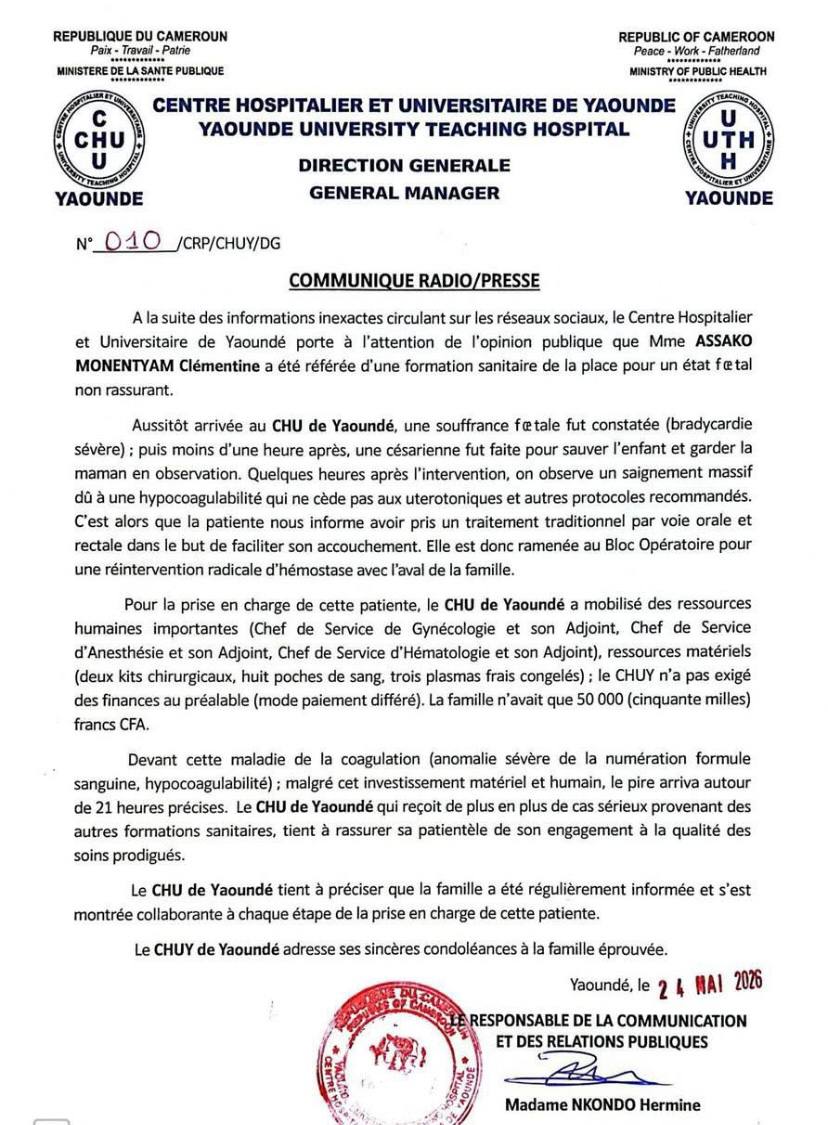
CHU Yaounde further claimed that doctors later discovered she had previously taken traditional treatments orally and rectally to facilitate childbirth, which may have contributed to complications.
According to the hospital, despite medical protocols and emergency interventions, the bleeding could not be controlled, leading doctors to perform another surgical operation aimed at stopping the hemorrhage, with the consent of the family.
CHU Yaoundé insisted that significant medical and material resources were mobilized during he treatment, including senior gynecologists, anesthesiologists, hematologists, blood bags, and fresh frozen plasma.
The hospital also denied allegations that treatment was delayed because of money, emphasizing that no upfront payment was required and that treatment continued under a deferred payment arrangement despite the family reportedly having only 50,000 francs CFA at the time.
The institution maintained that the family was regularly informed and involved throughout the patient’s treatment process while extending condolences to the bereaved family.
The case has since generated widespread reactions online, with many Cameroonians calling for clarity and accountability regarding maternal healthcare and hospital procedures in the country.

