


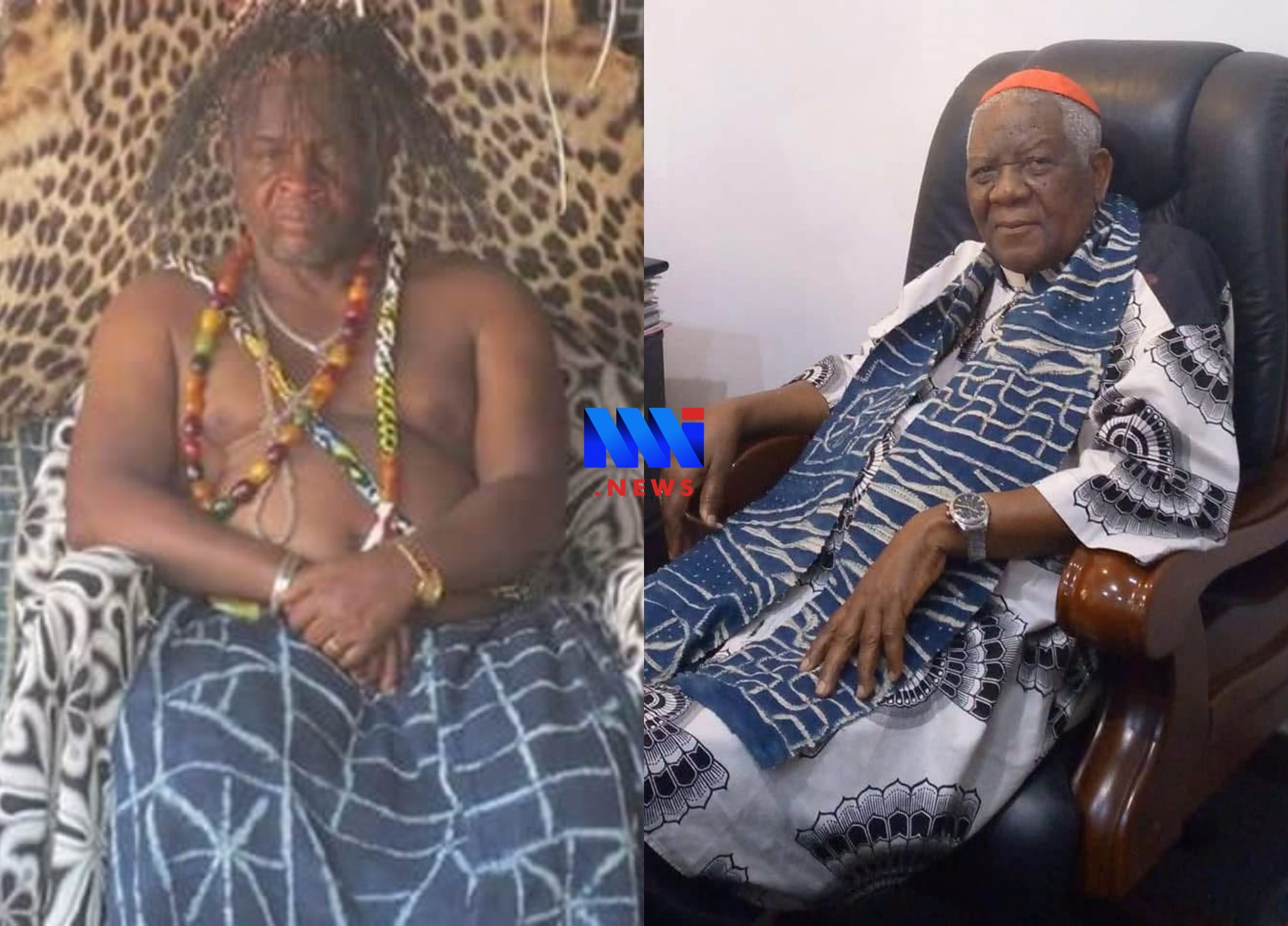

The Fon of Nso, Sehm Mbinglo I, has declared Sunday, October 25, 2026, a day of tribute to the late Cardinal Christian Wiyghan Tumi, bringing renewed attention to the life of a prominent son of Nso whose final years were marked by repeated calls for peace in Cameroon.
Sources close to the Nso Palace say the commemoration will centre on a memorial Mass in Douala, which the Fon is expected to attend.
Churches and mosques are also expected to organise activities in honour of the late cardinal, giving the tribute an interfaith character that mirrors Tumi’s long emphasis on dialogue and peaceful coexistence.
The day will remember Tumi as a Catholic leader, a public voice on governance and human rights, and a peace advocate during the conflict in Cameroon’s North West and South West regions.
From Kikaikelaki to the College of Cardinals
Christian Wiyghan Tumi was born on October 15, 1930, in Kikaikelaki, near Kumbo in present-day Bui Division of the North West Region.
After his early religious training, he studied and taught in Cameroon and abroad before being ordained a priest on April 17, 1966.
His church career later took him to Yagoua, where he became bishop in 1979, and then to Garoua, where he served as archbishop.
In June 1988, Pope John Paul II elevated him to the College of Cardinals, making him the first Cameroonian cardinal.
He later served as Archbishop of Douala from 1991 until his retirement in 2009.
Tumi died in Douala on April 3, 2021, at the age of 90.
A religious leader who spoke beyond the pulpit
Cardinal Tumi became known for speaking publicly on questions that went far beyond church administration.
He criticised corruption and poor governance and regularly spoke about democracy, human dignity and social justice.
Following his death, Pope Francis recalled Tumi’s commitment “with courage to the defence of democracy and the promotion of rights”.
For many Cameroonians, those public interventions made him one of the country’s most recognisable religious voices.
His positions sometimes brought him into direct disagreement with political authorities, but he continued to speak on national issues long after his retirement as Archbishop of Douala.
His peace advocacy during the Anglophone conflict
Cardinal Tumi became particularly involved in efforts to find a peaceful settlement to the conflict in Cameroon’s North West and South West regions.
The crisis, which began with protests by lawyers and teachers in 2016 before escalating into armed conflict, became one of the central issues of his later years.
Tumi repeatedly argued that condemnation alone would not end the violence.
“The crisis can no longer be healed by simple words or condemnation, but with concrete actions on the field,” he said in August 2019.
He was also one of the figures behind efforts to organise an Anglophone General Conference that would bring together people holding different positions on the conflict.
For Tumi, dialogue remained necessary even as the fighting deepened and mistrust grew between the government, separatist groups and affected communities.
The night Tumi and the Fon of Nso were abducted
The October 25 tribute also carries a personal significance for Fon Sehm Mbinglo I.
On November 5, 2020, Tumi and the Fon were travelling between Bamenda and Kumbo as part of efforts linked to peace and reconciliation in Nso when they were abducted in Ndop.
Reports at the time linked the abduction to armed separatists operating in the area.
Tumi spent the night in captivity and was released on November 6. The Fon remained in captivity for several more days before being released on November 10.
The experience later became the subject of Tumi’s book Ma Nuit en captivité — My Night as a Captive — written with Charles Ngadjifna and Martin Jumbam.
Rather than presenting the episode only as an account of violence, Tumi also wrote about conversations with some of the young fighters and what he believed those exchanges revealed about the human cost of the conflict.
That shared experience of captivity now gives the Fon’s tribute to Tumi an additional layer of meaning.
The two men were not linked only by Nso tradition and Catholic faith. They had also experienced together the dangers of trying to speak about peace in a region at war.
Tribute comes amid Fon’s renewed peace campaign
The declaration also comes as the Fon of Nso has renewed his own public emphasis on dialogue and reconciliation.
In September, the traditional ruler undertook a Royal Peace Mission to Noun Division and launched a book titled The Fon of Nso and the Anglophone Crisis: A Testimony for Reconciliation and Peace.
The publication is centred on his experiences during the conflict and his call for truth, forgiveness and peaceful coexistence.
The Cardinal Tumi Tribute Day therefore comes within a broader peace message now being advanced by the Nso Palace.
For the Fon, honouring Tumi also means returning attention to the peace efforts that shaped the cardinal’s final years.
Churches and mosques expected to take part
According to sources close to the palace, the main commemorative Mass will take place in Douala, where Tumi served as archbishop for nearly two decades.
The Fon of Nso is expected to attend.
Other churches are also expected to hold prayers and activities, while mosques have been invited to participate in the tribute.
That interfaith dimension is significant because Tumi repeatedly argued that lasting peace required dialogue across religious, political and ethnic lines.
The organisers hope the tribute will therefore go beyond Catholic remembrance and create a wider moment of reflection on coexistence and national unity.
Five years after his death, Tumi’s peace message returns
Five years after Cardinal Tumi’s death, the conflict he spent his final years trying to address remains unresolved.
Communities in the North West and South West continue to live with the effects of insecurity, displacement and violence.
Tumi’s last years were defined by his insistence that military confrontation alone would not resolve the crisis.
In writings after his kidnapping, he returned repeatedly to the hope that the fighting would end.
“All I want is for the guns to fall silent and for peace to return to the country,” he wrote.
The October 25 tribute will therefore remember more than a senior Catholic cleric.
For Nso, it will honour a son of the community who rose to the highest levels of the Catholic Church while remaining deeply involved in the problems facing his country.
For the wider public, the day will also revive a question that followed Tumi through the final years of his life: whether Cameroon can still find a political and peaceful way out of a conflict that has lasted for nearly a decade.