


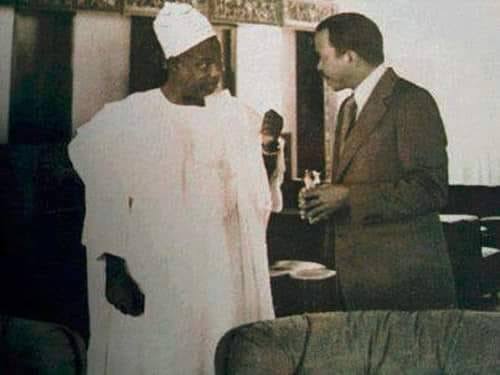
By Tata Mbunwe
Today, November 4, 2026, marks 44 years since Cameroon’s first president, Ahmadou Ahidjo, resigned and handed power to Paul Biya, his Prime Minister and constitutional heir, whom he had carefully positioned to succeed him by amending the consiconstitution.
The resignation message, broadcast on national radio, took listeners by storm. Ahidjo had ruled the country with an iron fist since independence in 1960 and was least expected to suddenly surrender power.
The resignation was followed two days later by the swearing-in of Paul Biya on November 6, 1982, as the country’s second head of state. Biya was 49 years old and a trusted ally of Ahidjo.
Ahidjo gave no specific reasons for his resignation but urged Cameroonians and external allies to trust Biya to lead the nation.
But trust between the two men would be short-lived. Cracks in the relationship began the following year. Ahidjo, who had retained the headship of the lone political party at the time, the CNU, resigned from the position in 1983 following disagreements.
On April 6, 1984, the Biya government foiled an attempted coup in which Ahidjo’s supporters were accused of plotting to overthrow the young president. Ahidjo himself was sentenced to death in absentia after going into self-imposed exile in Dakar, Senegal.
He lived there until November 30, 1989, when he died at the age of 65. He remains buried there alongside his wife, Germaine Ahidjo, who died in 2021.
Forty-four years after Ahidjo’s resignation, Biya, who turns 94 on February 13 next year, remains in power with six more years left in his current mandate. Last year, he defied age and health concerns to stand for an eighth term, which he won disputedly.
As Cameroonians reflect on Ahidjo’s resignation, comparisons are being drawn between the leadership of the only two presidents the country has known in 66 years.