


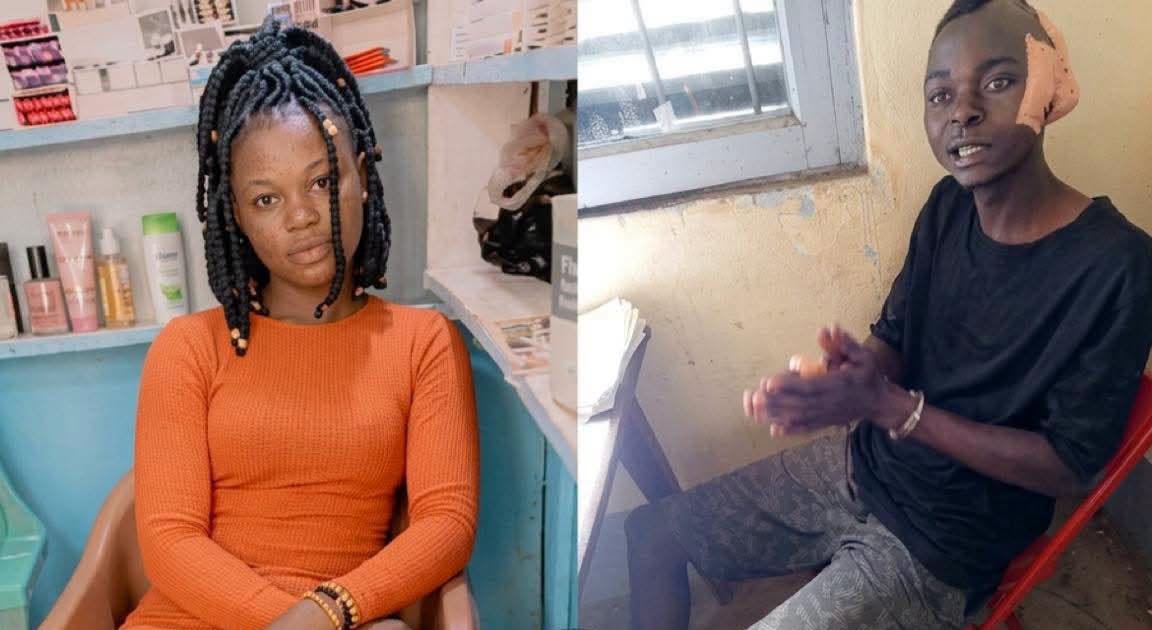

The killing of Daïna Tikeng, the young woman, reportedly married for only two months, comes amid a sharp rise in killings of women in Cameroon and renewed questions over whether victims of domestic violence have anywhere safe to go when they decide to leave.
Daïna Tikeng did what women trapped in violent relationships are often told they must do: she left.
For weeks, according to accounts from people familiar with the couple, the young woman had endured repeated violence from the man she had married only about two months earlier. Eventually, she moved away from the marital home and sought safety elsewhere.
But leaving did not end the danger.
Daïna was later found dead in a bushy area on the outskirts of Yaoundé. Her husband, Malayo Meli, a motorcycle taxi rider, has since been arrested in connection with her killing.
The case has shocked many Cameroonians, not only because of the manner in which the young woman died, but because she had already tried to remove herself from the situation that threatened her.
She left, but he found her.
Accounts circulating since Daïna’s death say she had been subjected to repeated physical violence by Meli and eventually decided to leave the relationship.
After she relocated, Meli reportedly traced her whereabouts and approached her saying he wanted to apologise and persuade her to return home.
What followed ended in her death.
According to accounts of the case, Daïna was taken away against her will, killed and her body abandoned in a bush outside Yaoundé. Local reporting says her throat had been cut.
The exact location where her body was recovered has not yet been publicly established by the authorities.
What has become clearer, however, is what happened when the man now being held in connection with the killing was arrested.
Arrested near Mendong
Initial reports, including MMI News’ first brief on the case, indicated that Meli had been arrested while going about his motorcycle taxi business.
Subsequent reporting has provided more precise details.
Le Courrier du Cameroun reports that gendarmes arrested Meli late Tuesday morning, August 11, at Eloumdem-Bangossien, close to Mendong on the southwestern outskirts of Yaoundé.
He was reportedly found inside a vehicle parked at a car wash.
The publication further reports that Meli admitted involvement in Daïna’s killing after his arrest. MMI News has not yet obtained an official statement from the National Gendarmerie or prosecuting authorities independently confirming the reported confession or specifying what charges have been brought against him.
The investigation is therefore important not only for establishing precisely what happened to Daïna, but also for determining what happens next to the man being held over her death.
Daïna is not an isolated case
Her killing comes against an increasingly disturbing backdrop. The Diane Yangwo case showed how fears of impunity can become part of the femicide crisis itself.
Diane, a 31-year-old teacher and mother of three in Douala, died in November 2023 after being violently assaulted by her husband, Éric Bekobe Mvondo.
But it was what happened in court nearly 18 months later that caused national outrage.
On April 1, 2025, the Wouri High Court sentenced Bekobe to five years in prison with the sentence suspended, along with a fine of just FCFA 52,000.
The decision triggered protests, petitions and widespread condemnation. Women’s-rights activists warned that punishments perceived as trivial could embolden abusive partners rather than deter them.
Diane’s family appealed.
Six months later, on October 15, 2025, the Littoral Court of Appeal increased Bekobe’s sentence to 20 years in prison.
The eventual tougher sentence was welcomed, but the case left behind an uncomfortable question: should it require months of public outrage and a family’s persistence through an appeal before the killing of a woman by her partner attracts a serious custodial punishment?
Just weeks ago, MMI News was asking similar questions following the death of Eyong Ashu Christy, a young nursing student stabbed to death in Kumba.
Christy was killed in June. A man widely identified in accounts of the incident as “Pastor Clinton” was reported to have been taken into custody, yet weeks later MMI News could obtain no official confirmation about where he was being detained, whether a case file had been opened or whether the matter had reached the State Counsel.
Read: Two Weeks On, No Answers: The Silence Around Eyong Ashu Christy’s Death
In September 2025, another woman — a recently qualified state nurse — was killed by her husband in Dschang. She was attacked and repeatedly stabbed as she returned home from work. Her husband subsequently surrendered to police and confessed, according to information available at the time. Two young children were left without their mother.
Read: Dschang Mourns as Husband Murders Wife in Brutal Attack
And these are simply the cases that become names, photographs and headlines.
50 women killed in four months
In June, Cameroon’s own government acknowledged the scale of the problem.
Responding to lawmakers in the National Assembly on June 19, Minister of Women’s Empowerment and the Family Prof. Marie-Thérèse Abena Ondoa said the state had officially recorded 50 cases of femicide between January and April 2026 alone.
The ministry also acknowledged that many cases of violence are never reported because victims fear social reprisals, family pressure and stigma.
The figures mean that even before Daïna died, Cameroon had officially recorded scores of women killed in only the first four months of the year.
The statistics sit alongside an even wider problem of domestic abuse.
The most recent nationally representative data cited by Human Rights Watch show that 44% of Cameroonian women and girls aged 15 to 49 who are or have been in a relationship reported experiencing emotional, physical or sexual violence from a current or former partner.
Yet violence inside relationships continues to be treated in many communities as a private family matter rather than a danger requiring urgent intervention.
What happens when a woman decides to leave?
That question lies at the heart of Daïna Tikeng’s story.
She reportedly recognised the danger and left.
But where could she go?
A major Human Rights Watch investigation published in June found that Cameroon still has no comprehensive national policy or guidelines specifically coordinating the response to domestic violence. The organisation also found that the country has no central government-run network of residential shelters for women escaping abuse.
Officials interviewed by Human Rights Watch acknowledged that government services have limited resources and rely heavily on civil society organisations to support women facing domestic violence.
Women interviewed for the investigation described being passed from one government institution to another. Others said they encountered officials who encouraged reconciliation with abusive partners rather than helping them safely separate.
That makes the circumstances surrounding Daïna particularly troubling.
According to the accounts of her final days, the man she had fled returned presenting precisely what is so often offered after domestic violence: an apology and reconciliation.
She was later dead.
Human Rights Watch says a revised Family Code capable of addressing some of the structural inequalities affecting women has remained in draft form for more than 20 years. It has called for comprehensive legislation covering domestic violence, protection orders and properly funded survivor services.
The questions Daïna leaves behind
An arrest is important.
But an arrest cannot be where the story ends.
Was Daïna’s experience of violence known to relatives, neighbours or authorities before she was killed?
Had she sought help from any government institution?
If she had asked for protection after leaving her husband, what protection could the state realistically have offered her?
What warning signs existed before her death?
What charges will the suspect face?
And will the investigation and eventual prosecution remain visible after public attention moves on to another tragedy?
Those questions matter because Daïna’s killing did not happen in a country unaware of its domestic violence problem.
The government has strategies against gender-based violence. It has ministries, police, gendarmes, courts and social services. Cameroon is also bound by international agreements, including the Maputo Protocol and the Convention on the Elimination of All Forms of Discrimination against Women, requiring the state to prevent violence, protect women and provide effective remedies.
Yet women continue to die.
For Daïna, leaving the marriage should have been the beginning of safety.
Instead, it appears to have been the beginning of the final chapter of her life.
Her death now leaves Cameroon with a question much bigger than who killed her:
When a woman finally finds the courage to leave a violent home, who makes sure she survives the decision?