


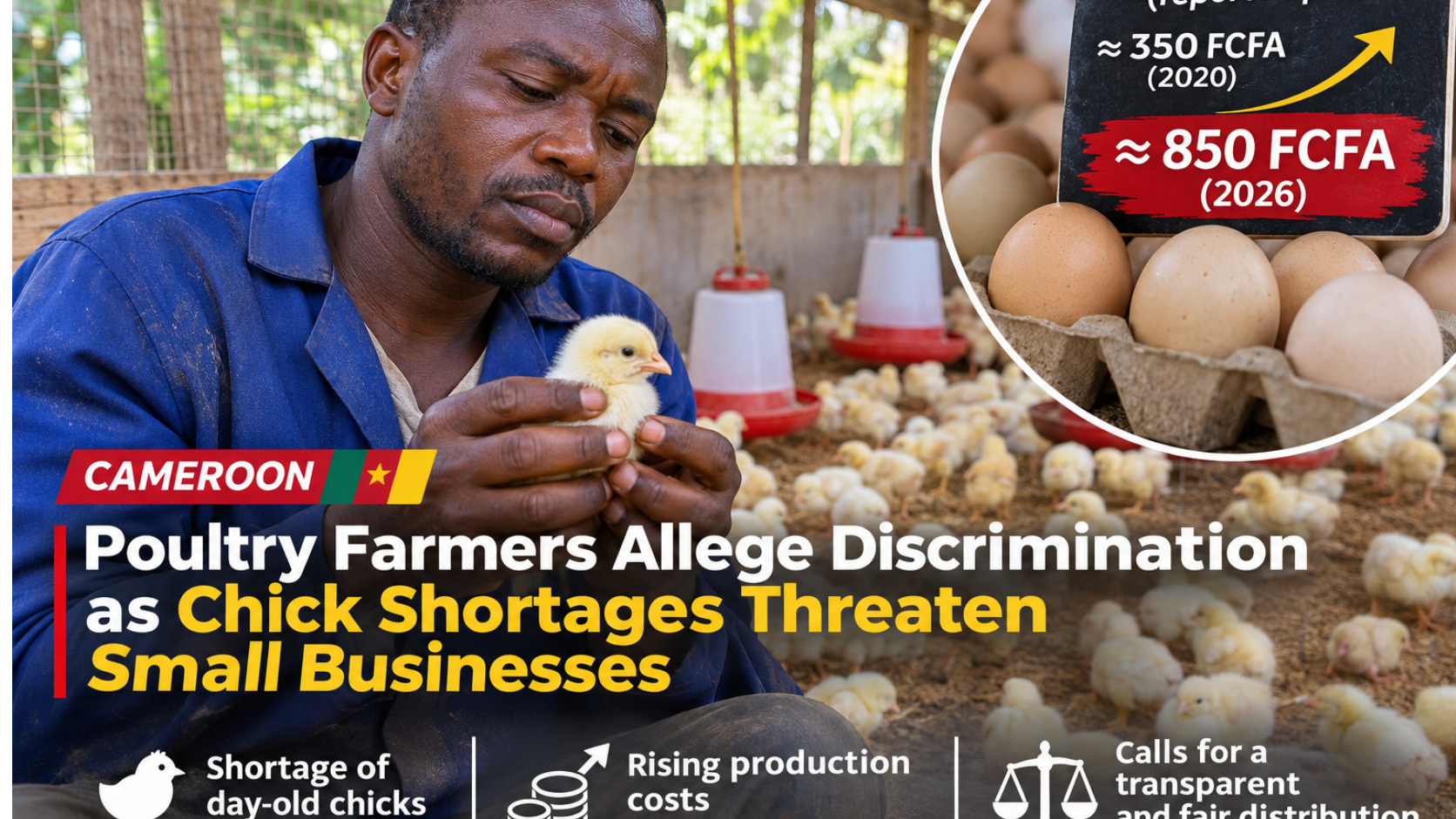

Small-scale poultry farmers in Cameroon’s North-West and South-West Regions are calling for government intervention over rising production costs, shortages of day-old chicks and allegations of discrimination in the distribution of essential farming supplies.
In an appeal shared with MMI News, the farmers say difficulties obtaining hatching eggs and day-old chicks are pushing some producers out of business and threatening livelihoods in a sector already affected by high operating costs and insecurity.
They are particularly concerned about the prices of hatching eggs, which they claim have risen from approximately 350 FCFA in 2020 to 850 FCFA in 2026.
The reported increase has not been independently verified through supplier invoices or official price records. However, evidence from government institutions and independent food-security organisations shows that shortages of poultry inputs have affected Cameroon’s farming sector for several years.
The farmers also allege that some suppliers favour customers from their own ethnic communities when allocating limited stocks of chicks and hatching eggs.
They claim that applicants from other communities sometimes struggle to obtain supplies, even after submitting formal requests.
MMI News has not independently established that ethnic discrimination determines the allocation of chicks, and no specific supplier has been identified in the appeal.
Nevertheless, the allegations raise questions about transparency in a market where access to essential supplies can determine whether a small farming business survives.
A shortage documented for years
The difficulties described by the farmers are not new.
Cameroon’s South West Development Authority (SOWEDA), a government development agency, has previously identified the scarcity of day-old chicks as a major constraint on poultry production in the South-West Region.
In its Livestock and Fisheries Development Project documentation, which includes historical assessments of the sector, SOWEDA reported that poultry farmers depended on suppliers in Douala and sometimes faced lengthy delays before receiving their orders.
The agency also identified expensive animal feed, inadequate production infrastructure and limited access to finance as obstacles facing smaller livestock producers.
Independent food-security monitoring has reached similar conclusions.
In its October 2022 Cameroon Food Security Outlook, the Famine Early Warning Systems Network (FEWS NET) reported that restrictions on imports of fertile eggs had contributed to shortages of day-old chicks and reduced poultry production.
Its assessment found that poultry prices had doubled across many markets during that period, while farmers struggled to sustain production.
A subsequent FEWS NET report in October 2023 found that poultry production in the conflict-affected North-West and South-West Regions remained constrained by shortages of day-old chicks.
The report also documented the impact of insecurity, disrupted markets and reduced agricultural incomes on households in both regions.
More recently, in November 2026, Cameroonian agricultural marketplace Jangolo reported continued complaints from farmers about delayed supplies and difficulties obtaining chicks ahead of the end-of-year festive season.
Its assessment published on November 3 identified dependence on imported breeding stock, high feed costs and seasonal demand as factors affecting the market.
These findings support concerns about supply difficulties, although they do not independently establish the discrimination alleged in the latest appeal.
What happened to the 2020 import restrictions?
The farmers have linked their difficulties to restrictions introduced in 2020.
That year, Cameroon’s Ministry of Livestock, Fisheries and Animal Industries restricted imports of day-old chicks and hatching eggs from countries affected by highly pathogenic avian influenza.
The measure was introduced to protect Cameroon’s poultry industry from animal disease.
However, the restrictions were subsequently modified.
In March 2021, the government authorised imports of poultry products from Brazil, which was considered to meet the relevant animal-health requirements.
The authorisation was discussed in an interview published by Cameroon Tribune on June 7, 2021 with François Djonou, then president of the Cameroon Poultry Interprofession (IPAVIC).
Djonou explained that difficulties obtaining supplies from traditional markets and problems transferring funds to foreign suppliers had contributed to shortages.
The 2020 restrictions therefore cannot be treated as an unchanged nationwide ban that has remained in place ever since.
What remains unclear is whether existing import arrangements and local hatchery production are sufficient to meet demand, particularly among small-scale farmers who cannot place large orders.
Farmers question fairness of supply
Beyond the cost of production, the complainants say the distribution system itself deserves investigation.
According to the appeal, farmers are sometimes required to submit formal applications before being considered for supplies.
They allege that allocation decisions are not always transparent and that some applicants receive preferential treatment based on ethnic or personal connections.
Such allegations require careful investigation, including evidence of how suppliers process orders, determine priority and distribute available stock.
A requirement to book chicks in advance is not necessarily discriminatory. Hatcheries must plan production around the availability of fertile eggs, incubation periods and expected demand.
Indeed, Jangolo’s November 2026 report explains that farmers are often required to reserve chicks well in advance, particularly during periods of high demand. It also notes that larger customers may have easier access to suppliers than smaller producers.
However, where supplies are scarce, unclear allocation procedures can create opportunities for unfair treatment.
The farmers argue that businesses should have access to chicks regardless of ethnicity, region or social background.
“Poultry farming is a national economic activity, not an ethnic privilege,” the appeal states.
Their concerns are particularly serious in the North-West and South-West, where years of armed conflict have already affected transport, agricultural production and access to markets.
For a small farmer, delayed chick supplies can mean missing a planned production cycle, losing expected income and continuing to pay operating expenses without having birds to sell.
Government urged to investigate
The farmers are calling on the government to investigate the distribution of hatching eggs and day-old chicks, review supply arrangements and establish clearer procedures to prevent favouritism.
They also want investment in local hatcheries and breeding facilities to reduce dependence on imports.
Although the appeal is directed at the Ministry of Agriculture and Rural Development (MINADER), poultry production and authorisations for importing chicks and hatching eggs fall primarily under the Ministry of Livestock, Fisheries and Animal Industries (MINEPIA).
Government policy has identified poultry production as part of efforts to increase domestic agricultural output and reduce dependence on imports.
SOWEDA’s livestock development plans have also proposed strengthening local chick production facilities as a way to improve availability for farmers in the South-West.
The latest complaints raise questions about how these policies are reaching smaller producers, particularly those in regions affected by conflict.
They also raise questions for hatchery operators and industry representatives about the criteria used to allocate supplies when demand exceeds production.
MMI News has not yet obtained responses from MINEPIA, IPAVIC or suppliers regarding the allegations raised in the appeal.
The farmers want the government to establish whether existing distribution arrangements are fair, how many small producers are being excluded from supplies and what can be done to improve access.
“We are not asking for preferential treatment. We are demanding equal treatment, transparency and fairness,” the appeal states.
For Cameroon, the issue extends beyond individual farmers. Reliable access to chicks, affordable feed and functioning supply chains affects domestic poultry production, agricultural employment and the availability of chicken for consumers.
Whether discrimination contributes to the shortages remains to be established. But the documented difficulties in obtaining poultry inputs provide grounds for examining how Cameroon supplies and regulates a sector on which many small businesses depend.