

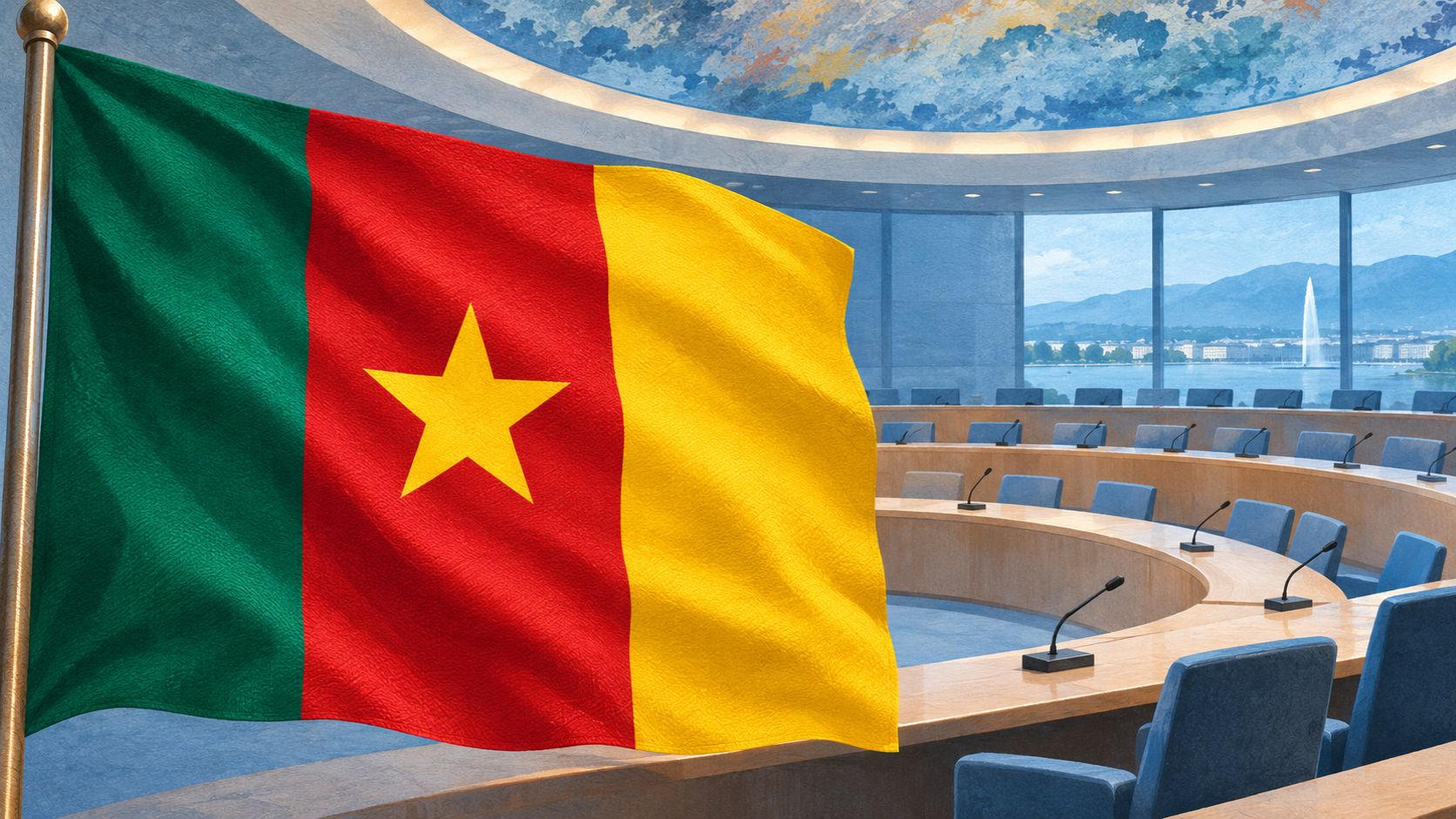

The UN Human Rights Committee urged Cameroon on Friday, 6 November 2026, to investigate alleged extrajudicial killings, enforced disappearances and torture by security forces, and to strengthen protections for civilians facing attacks by armed groups. It also called on the authorities to protect journalists and human rights defenders and to prevent criminal laws from being used to silence dissent.
The findings were released on the same day President Paul Biya marked 44 years in power. Biya was sworn in on 6 November 1982. The committee published its recommendations after examining Cameroon’s sixth periodic report on its implementation of the International Covenant on Civil and Political Rights at a hearing in Geneva on 22 and 23 October.
Abuses in the North-West, South-West and Far North
The committee raised concerns about reported killings, abductions and sexual violence attributed to separatist armed groups in the North-West and South-West regions and to groups linked to Boko Haram in the Far North. It separately cited allegations of extrajudicial executions, enforced disappearances and torture by Cameroonian security forces.
The committee also questioned the role of civilian vigilante groups in counter-terrorism operations. At the October hearing, an expert noted that Cameroon’s own report acknowledged the presence of vigilantes in Ngarbuh, where civilians were killed. The expert asked what legal authority the groups had, who oversaw them and how many members had been prosecuted. The hearing also raised questions about discrepancies in the number of civilians reported killed in Ngarbuh and what reparations their families had received.
The committee urged the authorities to ensure security operations comply with Cameroon’s human rights obligations, investigate alleged violations by security forces and abuses by armed groups, and hold those responsible to account. It also raised concerns about attacks on the Indigenous Mbororo community and called for humanitarian access, protection and basic services for people displaced by violence.
Cameroon says security personnel have been disciplined
At the Geneva hearing, Cameroon’s delegation said security forces receive training on the use of force and face disciplinary proceedings when they use it excessively. The delegation told the committee that 15 members of the gendarmerie had been sanctioned in 2025 for offences related to excessive use of force.
Cameroon’s representative to the UN in Geneva, Eheth Salomon, also pointed to reforms that he said had given the national human rights commission a broader mandate and greater financial independence. The committee’s chair welcomed the strengthening of national human rights institutions but said concerns remained about the treatment of detainees and the trial of civilians in military courts.
UN cites killings of Martinez Zogo and Jean-Jacques Ola Bebe
The committee cited the killings of Martinez Zogo and Jean-Jacques Ola Bebe in its findings on threats, intimidation and violence against journalists and human rights defenders. Zogo, who ran the private radio station Amplitude FM and used his programme to discuss corruption allegations, was found dead on 22 January 2023, five days after he was abducted. Ola Bebe, a radio presenter and commentator, was found dead near his home in Yaoundé in early February 2023. He had discussed Zogo’s killing on television shortly before he disappeared.
During the October hearing, a committee member asked why suspects in the killing of a civilian journalist were being tried before a military tribunal and whether all those suspected of instigating the crime were being prosecuted. The trial, which began in March 2024, is due to resume on 16 November 2026 at the Yaoundé Military Tribunal, according to Cameroonian outlet Le Bled Parle.
Committee calls for changes to defamation and counter-terrorism laws
The committee raised concerns about prison sentences and other criminal penalties under laws on defamation, false news, cybercrime and terrorism. It urged Cameroon to consider decriminalising defamation and to prevent criminal and counter-terrorism laws from being used to suppress dissent.
It also called for stronger guarantees of independence for the National Communications Council, judicial oversight of its decisions and an end to arbitrary restrictions on internet access. The committee urged Cameroon to protect journalists and human rights defenders from reprisals.
The recommendations, formally known as concluding observations, were published alongside findings on Austria, Jamaica and Rwanda. UN Human Rights Committee session documents.