


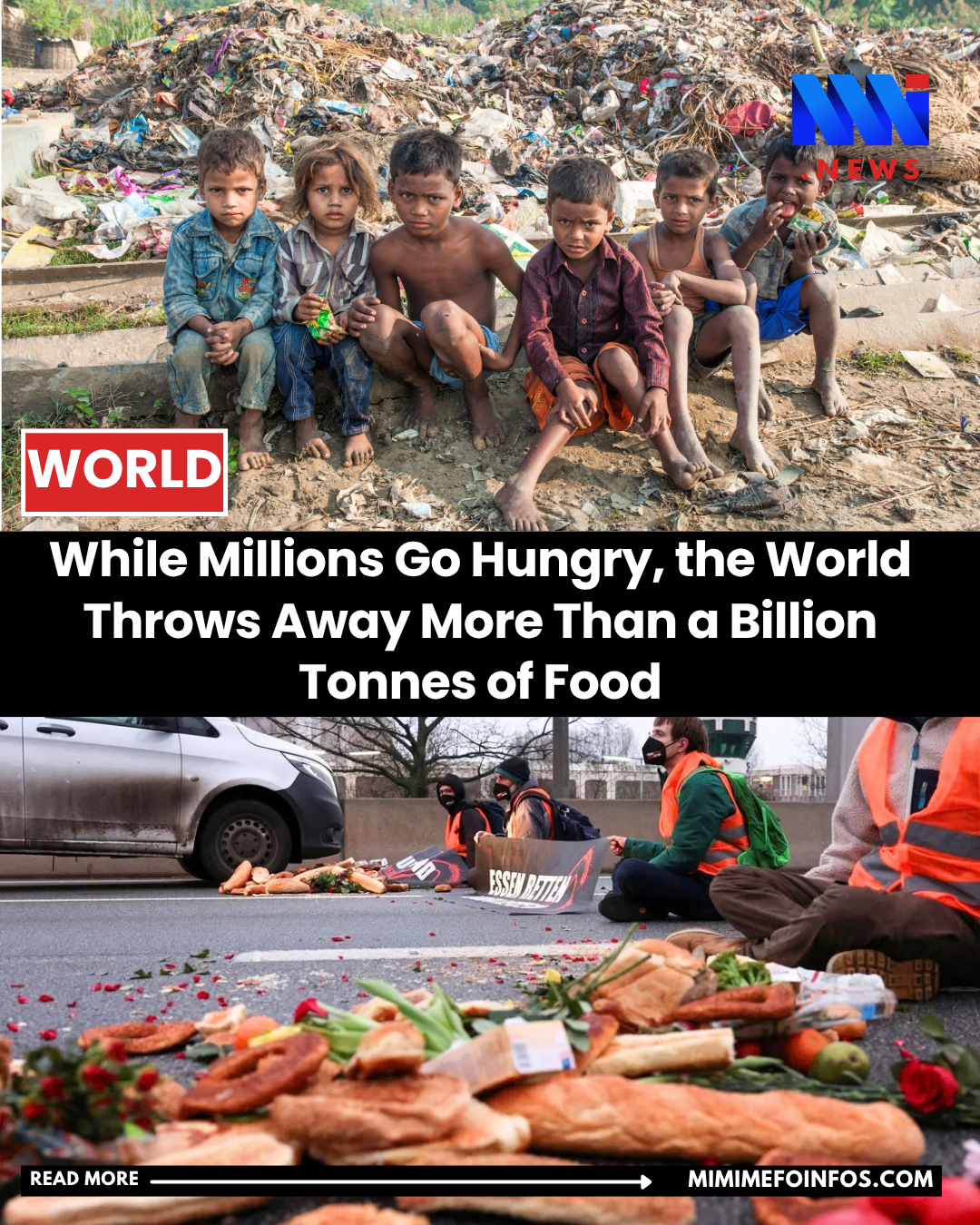

Every day, food is dumped from homes, restaurants and supermarkets while families elsewhere struggle to find their next meal. On the International Day of Awareness of Food Loss and Waste, MMI News looks at how both realities can exist at the same time.
Somewhere in the world today, a family will go to bed without enough to eat.
Somewhere else, a restaurant will scrape untouched food into a bin. A supermarket will discard products it cannot sell. Fruit bought for a household will spoil before anyone eats it. Leftovers will be forgotten in a refrigerator and eventually thrown away.
Both things are happening on an enormous scale.
An estimated 645 million people faced hunger in 2025, according to the latest United Nations assessment. About 309 million of them were in Africa, where one in five people was undernourished.
Yet the latest comprehensive global estimate of food waste found that 1.05 billion tonnes of food were wasted in 2022 at household, restaurant and retail level.
Households were responsible for 631 million tonnes, or 60% of that waste. The United Nations Environment Programme estimates that households alone discarded the equivalent of more than one billion meals every day.
The figures present an uncomfortable question: if the world can afford to throw away so much food, why are hundreds of millions of people still hungry?
The answer is that hunger is rarely as simple as the world not producing enough food.
It is also about whether people can afford food, whether it can reach them, whether farmers can preserve what they grow and whether war, poverty or broken infrastructure stands between food and the people who need it.
Food can be available and still be out of reach
A market can be full of food while families living a few streets away are hungry.
The problem may simply be money.
The World Bank estimates that around 2.7 billion people could not afford a healthy diet in 2025. In Sub-Saharan Africa alone, that figure exceeded 954 million.
For those households, the existence of food in shops does not mean they have access to it. A parent choosing between rent, medicine, school expenses and food may have to reduce portions, skip meals or buy the cheapest available food rather than what a family needs nutritionally.
Conflict makes that problem much worse.
The World Food Programme says 70% of people facing acute food insecurity live in fragile or conflict-affected countries. Fighting can force farmers off their land, destroy markets and roads, displace families from their livelihoods and prevent humanitarian assistance from reaching communities.
Sudan offers one of the starkest examples. A country can have agricultural land, farmers and food production while war simultaneously leaves communities facing extreme hunger.
The same principle applies elsewhere: having food somewhere within a country or region does little for a family that cannot safely reach it or afford to buy it.
In Africa, much of the food disappears before reaching the plate
There is another important distinction behind the global numbers: food loss and food waste are not exactly the same thing.
Food loss generally happens before food reaches shops and consumers. Crops can be damaged during harvesting, rot in storage, spoil during transportation or be lost because farmers have no access to refrigeration or processing facilities.
Globally, about 13.2% of food is lost between harvest and retail, according to the UN.
This is especially important in parts of Africa.
The Food and Agriculture Organization says fragile post-harvest infrastructure, inadequate storage and limited cold chains across much of Sub-Saharan Africa mean that crops can spoil before reaching markets.
A tomato farmer may successfully grow a crop but have nowhere cold to store it. A fishing community may bring in a catch but lack reliable electricity for refrigeration. Produce may spend hours or days travelling over poor roads before reaching urban markets.
The result is food that was grown for people to eat but never reaches them.
That loss has consequences beyond hunger. Farmers lose income, consumers can face higher prices, and the land, water, fertiliser and labour used to produce the food are effectively wasted too.
In wealthier consumer markets, a larger part of the problem occurs at the opposite end of the chain.
Food has already survived harvesting, storage and transportation. It has reached supermarkets, restaurants and homes — and is then thrown away.
People may buy more than they can eat. Restaurants may prepare more food than customers order. Shops may discard products that are approaching their sell-by dates or are unlikely to sell. Fruits and vegetables can also be rejected because of their size, shape or appearance.
UNEP found that 19% of food available to consumers was wasted in households, food-service businesses and retail in 2022.
Food waste is not exclusively a rich-country problem, however. UNEP’s research found substantial household food waste across income groups.
Why not simply send wasted food to hungry countries?
It sounds like the obvious solution: if one part of the world has surplus food and another has people starving, why not move the food from one to the other?
Sometimes surplus food can and should be redistributed locally. Food banks and charities already collect usable food from supermarkets, restaurants and other businesses in many countries.
But shipping everyday surplus food across continents is a different matter.
Fresh food is perishable. It requires refrigeration, storage, fuel, transport and functioning roads and ports. Moving unwanted meals thousands of kilometres can cost considerably more than purchasing food closer to people who need assistance.
And it would not address the reasons those people became hungry in the first place.
A community cut off by war needs safe humanitarian access. A farming region losing produce after harvest needs storage, roads and processing facilities. Families priced out of the market need income or social protection. Farmers facing drought need resilient agriculture and water. Countries dependent on food imports may need stronger local production and more stable supply chains.
The contradiction, therefore, is not that one person’s discarded dinner could simply have been placed on another person’s plate thousands of kilometres away.
It is that the global food system can generate enough abundance for enormous quantities of food to become waste while still failing to give hundreds of millions of people reliable access to adequate food.
Africa’s numbers remain particularly troubling
There has been some progress.
The UN’s 2026 State of Food Security and Nutrition in the World report found that global hunger declined for a third consecutive year in 2025. The estimated number of people facing hunger fell by nearly 14 million from 2024.
Africa also recorded its first decline in the prevalence of hunger since 2017.
But the change was small.
About 20% of Africa’s population remained undernourished in 2025, compared with 6% in Asia and 4.8% in Latin America and the Caribbean.
FAO projects that if current trends continue, Africa could account for more than half of the world’s hungry people by 2030.
Meanwhile, roughly 2.1 billion people worldwide experienced moderate or severe food insecurity in 2025, meaning uncertainty about obtaining enough safe and nutritious food remains far more widespread than the headline hunger figure alone suggests.
What September 29 is asking the world to confront
September 29 is the International Day of Awareness of Food Loss and Waste, led by FAO and UNEP.
The 2026 observance is centred on the “Transformative Potential of Reducing Food Loss and Waste.”
The argument is not that eliminating waste would automatically end hunger.
It is that allowing food to rot after harvest or throwing it away after it reaches consumers makes little sense in a world where hundreds of millions of people remain undernourished.
Reducing those losses could help farmers keep more of what they produce, improve the amount of food reaching markets, reduce pressure on food prices and save the water, land and energy used to produce food that currently goes uneaten.
There is an environmental cost too. UNEP estimates that food loss and waste are responsible for 8% to 10% of global greenhouse gas emissions.
So the food thrown into a bin is not only a missed meal. Behind it are the land on which it was grown, the water used to produce it, the farmer who worked for it, the fuel used to transport it and the emissions generated along the way.
The world may be making slow progress against hunger. But 645 million people still going hungry while more than a billion tonnes of food are wasted remains one of the clearest signs that producing food and ensuring people can eat it are two very different things.
#MMINews