


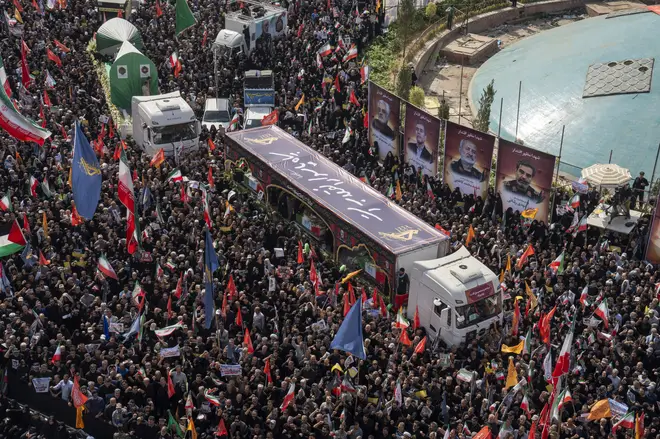
Hundreds of thousands, possibly over one million mourners, lined Azadi Street in downtown Tehran on Saturday for the state funeral of senior Islamic Revolutionary Guard Corps (IRGC) commanders and nuclear scientists killed during the recent 12-day conflict with Israel. Among the deceased were IRGC chief General Hossein Salami and General Amir Ali Hajizadeh, head of the Guard’s ballistic missile programme.
Confirmed Casualties and Funeral Details
On June 13, Israel launched an offensive targeting Iran’s nuclear and military infrastructure, resulting in the deaths of Salami and Hajizadeh. State media honoured 60 individuals in the procession, including four women and four children. Mourners chanted “Death to America” and “Death to Israel” as trucks drove coffins draped in Iranian flags along the full 4.5-kilometre route.
Supreme Leader Not Present
Key officials present included Foreign Minister Abbas Araghchi, President Masoud Pezeshkian, and IRGC Quds Force commander General Esmail Qaani Notably absent was Supreme Leader Ayatollah Ali Khamenei, who has made no public appearance since the conflict began. Khamenei has historically led prayers at such ceremonies, but delivered only a pre-recorded statement since hostilities ceased.
Conflict Overview and Aftermath
Israel’s air campaign, launched June 13 and intensified with U.S. support on June 22, aimed at halting Iran’s nuclear ambitions. Iran responded by firing over 550 ballistic missiles, Iranian government figures report 610 deaths and more than 4,700 injured; activist monitors estimate nearly 974 fatalities. In Israel, 28 were killed and over 3,200 injured.
Political Messages from Mourning
The funeral underscored national defiance and continuity of Iran’s nuclear stance. Foreign Minister Araghchi criticized U.S. President Donald Trump’s rhetoric, stating, “‘If President Trump is genuine about wanting a deal, he should put aside the disrespectful and unacceptable tone towards Iran’s Supreme Leader’” Parliament likewise moved to limit International Atomic Energy Agency access to nuclear sites.
Implications and Regional Dimensions
The funeral served both as a national demonstration of solidarity and as a signal of internal resolve amid escalating U.S.–Israel–Iran tensions. With Iran suspending parts of IAEA cooperation and threats of further military action from Tehran, the event may influence future diplomatic efforts and regional stability.

