


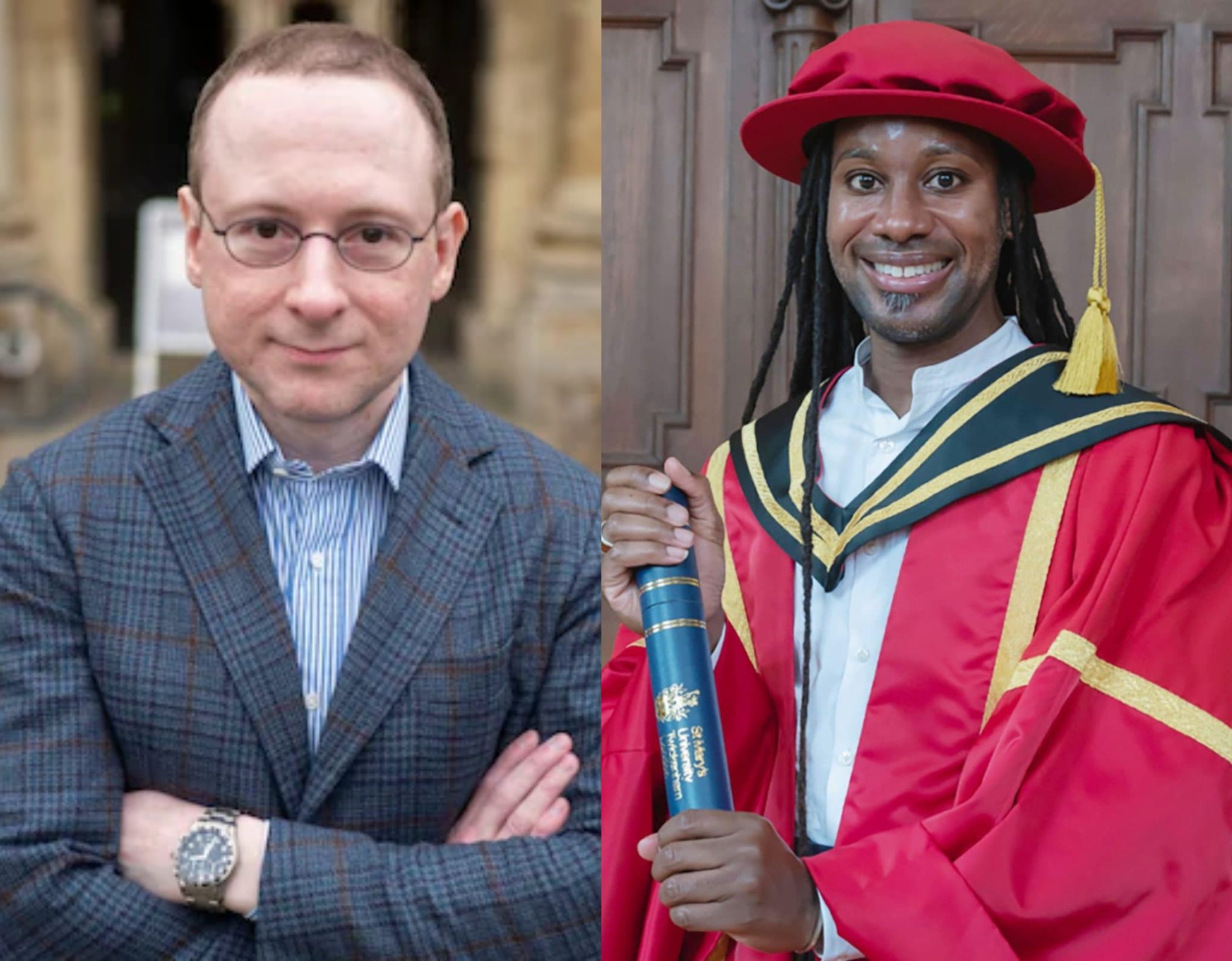

The plagiarism questions around Professor Jason Arday were legitimate. But the man who helped push them into public view had himself publicly advanced a proposition that has attracted far less scrutiny than it deserves — that inherited differences in intelligence help explain racial inequality. Britain interrogated one Black professor. It has barely begun to interrogate the ideas of one of his most prominent accusers.
Jason Arday was found unresponsive at an address in Battersea, south London, on Friday. He was 41. The Metropolitan Police say his death is being treated as unexpected but not suspicious, and there is no basis on which to attribute it to any individual. The questions raised about his academic record do not vanish because he has died, and this piece does not suggest otherwise. But the campaign that surrounded him, and the ideas of the man who helped drive it, do not become off-limits either.
Arday had resigned from Cambridge nine days earlier, on 5 August, having been the youngest Black professor in the university’s history when he was appointed in 2023. His family, in a statement issued through his publisher, described a campaign of harassment and misinformation that had become too much for a gentle man who wanted to see the best in everyone. The autism researcher Simon Baron-Cohen, who says he spoke to Arday in his final hours, told the BBC that his colleague was facing relentless scrutiny that discredited every detail of his life, and had come to feel he could not go on. According to Baron-Cohen, Arday believed there was a “racist playbook” used to bring down Black academics through accusations of plagiarism, and pointed to the case of the former Harvard president Claudine Gay.
Whatever one makes of that belief, it deserves to be examined rather than dismissed — because one of the figures who did most to make Arday a national story was already on record with an argument that gives it a disquieting shape.
What Cofnas actually argues
Nathan Cofnas is a philosopher of biology who held a Leverhulme early-career fellowship in Cambridge’s philosophy faculty until it ended. In publicising his own investigation into Arday, he called him a “DEI superstar” and led with the fact that he was Cambridge’s youngest Black professor, an essay he titled around the theme of fraud and cover-up. That framing was not incidental. It told readers what the story was supposed to mean.
To understand why that matters, you have to go back to February 2024, and to the essay that made Cofnas notorious. In A Guide for the Hereditarian Revolution, he argued that the only realistic route to defeating “wokeism” was for elites to accept what he calls “race realism”: the view that population groups differ, on average, in genetically-influenced intelligence. From that premise he drew a set of conclusions about who belongs at the top of society. On a colourblind system judging applicants by academic qualifications alone, he wrote, Black students would fall to around 0.7 per cent of Harvard’s intake; the number of Black professors would “approach 0%”; and Black people would “disappear from almost all high-profile positions outside of sports and entertainment.”
Strip away the vocabulary of data and revolution and a plain proposition remains. If removing measures designed to counter historic disadvantage would leave almost no Black professors at the world’s leading universities, and if the explanation offered is partly inherited difference in intelligence, then the underlying claim is that Black people, taken as a group, are less intellectually capable than others.
That is not a caricature of the argument. It is the argument. That conclusion is not being imposed on an argument about representation alone. It follows from Cofnas’s own attempt to connect racial outcomes to inherited differences in intelligence.
And it is worth saying clearly that this is contested territory even on its own scientific terms. The proposition that average group gaps in test scores are substantially genetic is not settled science; it rests on assumptions about heritability across populations that mainstream researchers dispute. Cofnas presents as fact something that remains, at best, a fiercely argued minority position.
Haven’t we heard this before?
Nearly three centuries ago, David Hume looked at a world in which Europeans ran the institutions of learning and commerce while Africans were being enslaved and subjected to European domination and treated the absence of Black people from European achievement as evidence of natural inferiority. The Stanford Encyclopedia of Philosophy situates that judgement within a wider European tradition that ranked the races and lent colonial domination the appearance of reason. Kant refined the hierarchy; Hegel wrote sub-Saharan Africa out of world history altogether; Lévy-Bruhl reached for the language of the “pre-logical” mind, though his own thinking grew more complicated than the label suggests.
These were not idle speculations. They supplied intellectual architecture to societies already built on slavery and exclusion, dressing an unequal distribution of power as a natural fact and then citing that same inequality as proof of European superiority. The manoeuvre was circular, and its circularity was the point.
Cofnas is not Hume, and Britain in 2026 is not the eighteenth century. But the structure of the reasoning rhymes. The old argument looked at Black absence from powerful institutions and asked what it proved about Black people. The better question has always been what it proves about the institutions.
Is exclusion proof of merit?
This is where the appeal to “meritocracy” needs far harder handling than it has had. The latest HESA figures show roughly 270 Black professors across UK universities in 2024/25 — about 1 per cent of the total. At Cambridge the proportion is smaller still. Confronted with that, Cofnas’s logic runs one way: remove the interventions, and the numbers fall further, because ability will reveal itself.
But there is a more straightforward reading, and the evidence sits behind it. The Office for Students has documented persistent inequalities that follow Black students through higher education and into postgraduate research, the pipeline from which professors eventually emerge. Advance HE finds Black academics the most under-represented group in the professoriate. And census data records that a high proportion of people identifying as African in England and Wales hold degree-level qualifications — one of the highest rates of any group. Highly educated Black people enter the system in strength and thin out to near-invisibility by its most senior rungs.
So why reach first for “merit” to explain the gap, rather than recruitment, networks, funding, mentorship, the reach of elite schools, or plain discrimination? The deeper flaw is this: Cofnas takes the present racial composition of institutions built over centuries in a profoundly unequal society and treats it as the neutral baseline against which merit is to be measured. But that composition is not a starting line. It is a result — the accumulated product of the very barriers a genuine meritocracy would have to strip away. To point at the outcome and call it the natural order is to mistake the effect for the cause. Meritocracy cannot mean removing Black people and then treating their absence as proof they were never owed a place. That is circular reasoning wearing the costume of objectivity.
The asymmetry
Which returns us to Jason Arday, and to the most uncomfortable feature of this whole affair.
Arday’s alleged failings were treated with forensic seriousness. His thesis was set beside its sources passage by passage; his CV, his employment history, his fundraising and his personal biography were all combed through. Cambridge opened an investigation on 5 August after what it described as new information about his qualifications and honorary appointments. He should not have been held to a lower standard because he was Black. Nor should he have carried a heavier one.
Yet the man who helped set that scrutiny in motion had advanced, in public, a thesis that almost no Black people merit senior positions at all — and that thesis met nothing like the same interrogation. Cambridge received 58 formal complaints about Cofnas. Its disciplinary body dismissed every one, and external lawyers concluded his blog amounted to lawful academic expression rather than harassment or discrimination, while allowing that some passages could create a hostile environment if the legal threshold were met. Emmanuel College cut its ties with him; the university’s pro-vice-chancellor for education, Bhaskar Vira, told colleagues he had “crossed a line.” The principal of Homerton College, Lord Simon Woolley, was blunter, calling the views “abhorrent racism masquerading as pseudo intellect.”
None of that is the same as the line-by-line examination Arday received. Freedom of speech protected the argument’s right to exist. It did not oblige anyone — university, press or public — to treat the argument as intellectually neutral, and by and large the second interrogation never came.
A question about Britain, not two men
The deepest question here is not really about either man. It is about what we assume when we look at an institution and see almost no Black faces at its summit. That Black scholars are not good enough? Or that a system assembled over centuries of inequality has carried some of that inequality forward into the present?
The distinction is not academic. A university can hold every appointment to merit and still ask whether everyone had an equal chance to accumulate the publications, contacts, funding and recognition through which merit is measured. To skip that question and declare today’s outcomes the natural yield of ability is to repeat one of history’s oldest errors: mistaking inequality for inferiority.
The media-reform group Hacked Off has called for an inquiry into press conduct around the case, arguing the scrutiny went far beyond any genuine public interest. The Prime Minister, Andy Burnham, called the death “a tragedy on so many levels” and urged reflection rather than a rush to judgement. Reflection is the right instinct. But it should extend past the tragedy of one man to the logic that framed him.
Why was the possibility that a single Black professor had not earned his chair treated as a crisis for meritocracy, while the suggestion that scarcely any Black person could earn such a chair at all was treated, principally, as a matter of free speech?
That is not a question about Jason Arday. It is a question about Cambridge, and about Britain.