


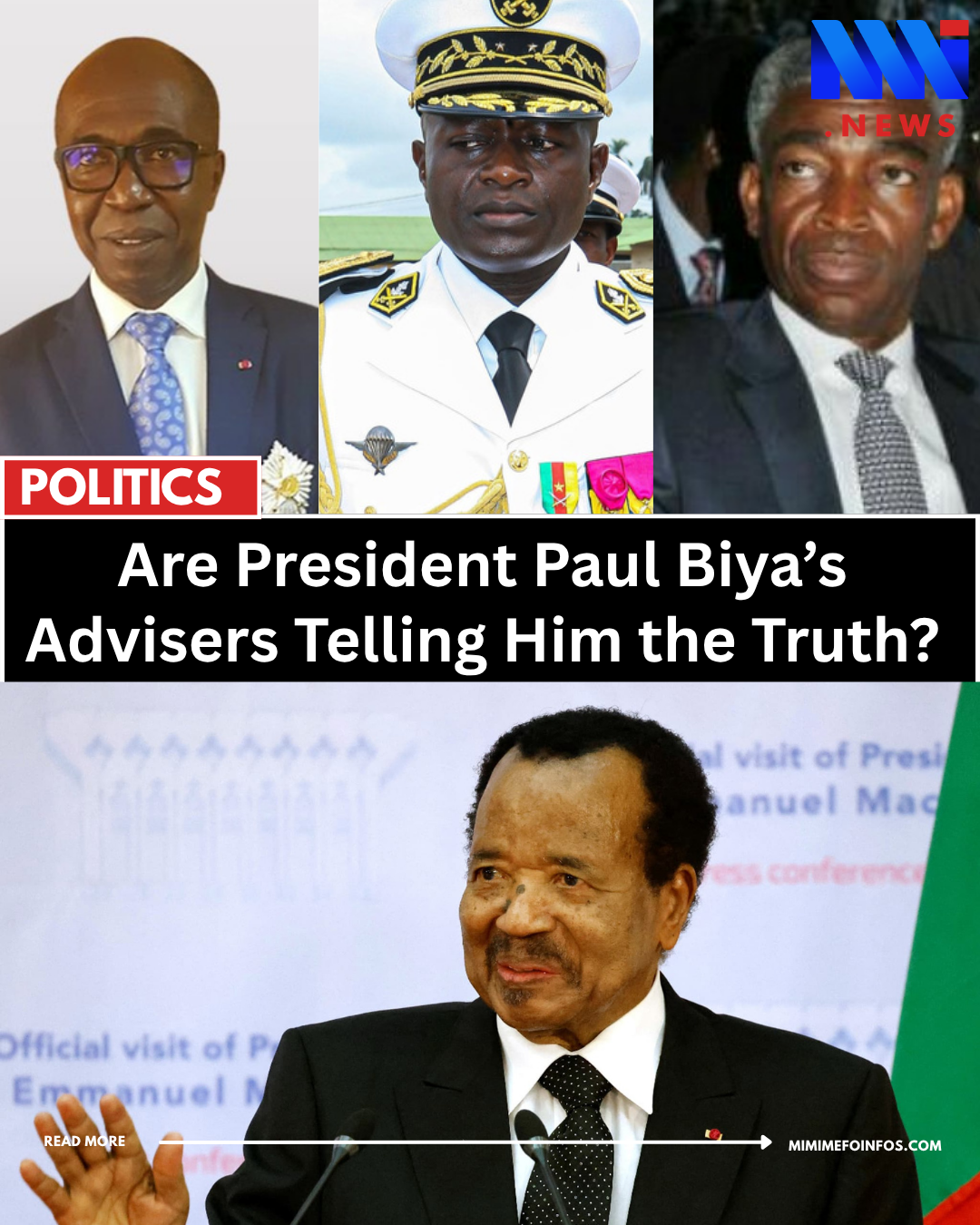
They rarely grant interviews. They seldom appear in public. Yet they are among the most powerful figures in Cameroon. While President Paul Biya remains the public face of the country’s leadership, a small circle of trusted advisers has, for decades, occupied some of the most influential positions in the presidency. Their role is to provide political, security and economic counsel to the Head of State, helping shape decisions that affect nearly 30 million Cameroonians.
As Cameroon faces an armed conflict in its English-speaking regions, economic hardship, rising public debt and increasing political uncertainty, questions are growing over the advice reaching the president.
Many Cameroonians have long argued that President Biya’s speeches, particularly his annual New Year and Youth Day addresses, often fail to reflect the daily realities facing citizens.
This has led to a broader question: Are those closest to President Biya giving him an accurate picture of the country he governs?
At 93, Paul Biya has spent more than four decades in power, making him the world’s oldest serving head of state. His advanced age has intensified public scrutiny over who influences decision-making inside the presidency.
While there is no public evidence to suggest the president is prevented from accessing independent information, advisers are constitutionally and administratively expected to provide accurate assessments and informed recommendations.
The President’s Inner Circle
Among the president’s closest advisers, three individuals stand out because of the strategic portfolios they oversee.
Each occupies a different sphere of influence—politics, national security and public finance.
Luc Sindjoun: The Political Brain
Political scientist Professor Luc Sindjoun has served as a Special Adviser to President Biya since 2009.
One of Cameroon’s most respected academics, Sindjoun has built his reputation through decades of teaching and research in political science and governance.
Inside the presidency, his responsibilities reportedly include advising the Head of State on political affairs, governance, diplomacy and long-term strategic issues.
In practical terms, this means analysing the country’s political climate, monitoring institutional developments and helping shape government policy.
Given his role, many believe few people should have a clearer understanding of Cameroon’s political mood than Sindjoun.
His proximity to the presidency raises important questions.
Has he accurately communicated the growing frustrations expressed by many Cameroonians over unemployment, governance, corruption, the cost of living and political reforms?
Has he advised the president on the widening disconnect many observers believe exists between the presidency and ordinary citizens?
Those questions remain unanswered because the presidency rarely discloses the advice offered by its senior advisers.
Vice-Admiral Joseph Fouda: The Security Gatekeeper
If one man has remained consistently close to President Biya throughout some of the country’s most sensitive security moments, it is Vice-Admiral Joseph Fouda.
Widely credited with helping protect President Biya’s government during the failed military coup attempt of April 1984, Fouda has remained one of the president’s most trusted security confidants.
His responsibilities reportedly include presidential security, defence strategy, military coordination and broader national security matters.
Unlike many presidential advisers, Fouda frequently accompanies President Biya on official and private trips.
His influence inevitably places him at the centre of discussions surrounding the government’s response to the conflict in Cameroon’s North West and South West regions.
For nearly a decade, authorities have largely pursued a military strategy alongside periodic political initiatives.
Whether alternative approaches have been proposed internally remains unknown.
The presidency has never publicly disclosed the range of security advice presented to Paul Biya as the Head of State.
Antoine Samba: Watching the State’s Finances
Economic decisions are another area where presidential advisers exercise significant influence.
Antoine Samba, a former Director General of the Budget and senior treasury inspector, serves as Special Adviser on financial and monetary affairs.
His responsibilities reportedly include evaluating public expenditure, monitoring budget implementation, analysing state finances and advising the president on fiscal policy.
His role has become increasingly important as Cameroon continues to rely on borrowing from international financial institutions to finance development projects and public expenditure.
This naturally raises further questions.
Has sufficient advice been given on reducing public debt?
Have concerns about government spending priorities been fully presented to the president?
Should more emphasis be placed on domestic investment in healthcare, education, infrastructure and employment?
These are policy questions that ultimately shape the daily lives of Cameroonians.
The Advisers Few Cameroonians Know
Despite occupying positions at the highest level of government, presidential advisers remain among the least publicly scrutinised officials in Cameroon.
Unlike ministers, governors or members of parliament, they rarely explain their positions publicly.
Their recommendations are confidential.
Their influence, however, can be enormous.
Many presidential decisions are likely informed, directly or indirectly, by the advice they provide.
Responsibility Beyond the President
Debates about Cameroon often focus exclusively on President Paul Biya.
Yet governance experts frequently note that decision-making within any presidency depends heavily on the quality of information reaching the Head of State.
An adviser has a duty to provide honest, evidence-based assessments, even when those assessments may be politically uncomfortable.
If critical realities are softened, ignored or filtered before reaching the president, decision-making inevitably suffers.
Conversely, if advisers are providing frank and accurate advice that is ultimately not acted upon, responsibility shifts to the president himself.
Without greater transparency from the presidency, the public has no way of knowing which of these scenarios reflects reality.
A Presidency Facing Growing Questions
As Cameroon approaches another election cycle, attention is increasingly shifting beyond President Biya himself to the advisers who help shape his decisions.
Who informs the president?
What information reaches his desk?
Are dissenting opinions encouraged inside the presidency?
Most importantly, do those entrusted with advising the Head of State accurately communicate the realities facing millions of Cameroonians?
Those questions may ultimately become just as important as the decisions the presidency itself continues to make.
Editor’s Note: This article is an analysis based on the publicly known responsibilities of presidential advisers and the broader public debate surrounding governance in Cameroon. The Presidency of the Republic does not make public the content of advice provided to the Head of State, and the specific recommendations of individual advisers remain confidential.

