



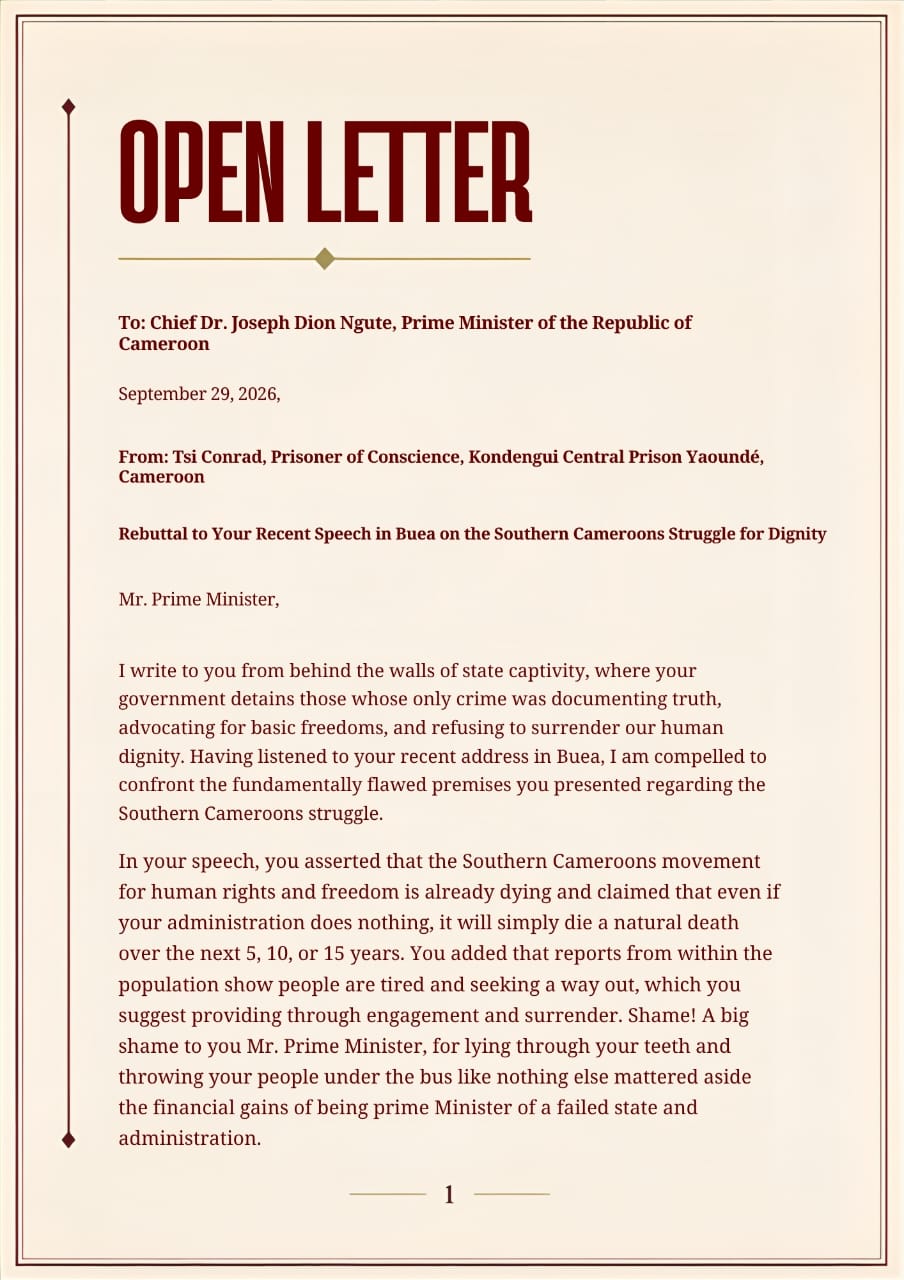
Jailed Cameroonian journalist Tsi Conrad has challenged Prime Minister Joseph Dion Ngute’s suggestion that the Anglophone conflict could “die a natural death”, arguing that exhaustion with violence does not mean communities have abandoned their demands for justice and political change.
In an open letter dated 29 September 2026, written from Kondengui Central Prison in Yaoundé, Conrad accused the government of relying on time to weaken Anglophone grievances without addressing the conditions that produced them.
He called for the release of political detainees, accountability for military abuses, restoration of civil liberties and inclusive political negotiations.
The letter responds to Dion Ngute’s remarks at a community dialogue and peace meeting in Buea on Monday, 28 September. Reporting from the meeting described the prime minister as saying the crisis was declining and could end naturally within another 10 or 15 years, while urging action to resolve it now. He also encouraged community leaders to persuade armed separatist fighters to lay down their weapons.
Conrad’s rebuttal challenges the political meaning of that assessment. He argues that a decline in fighting, or a population’s desire for relief, cannot be treated as the disappearance of demands for dignity, justice and self-determination.
War weariness does not mean surrender
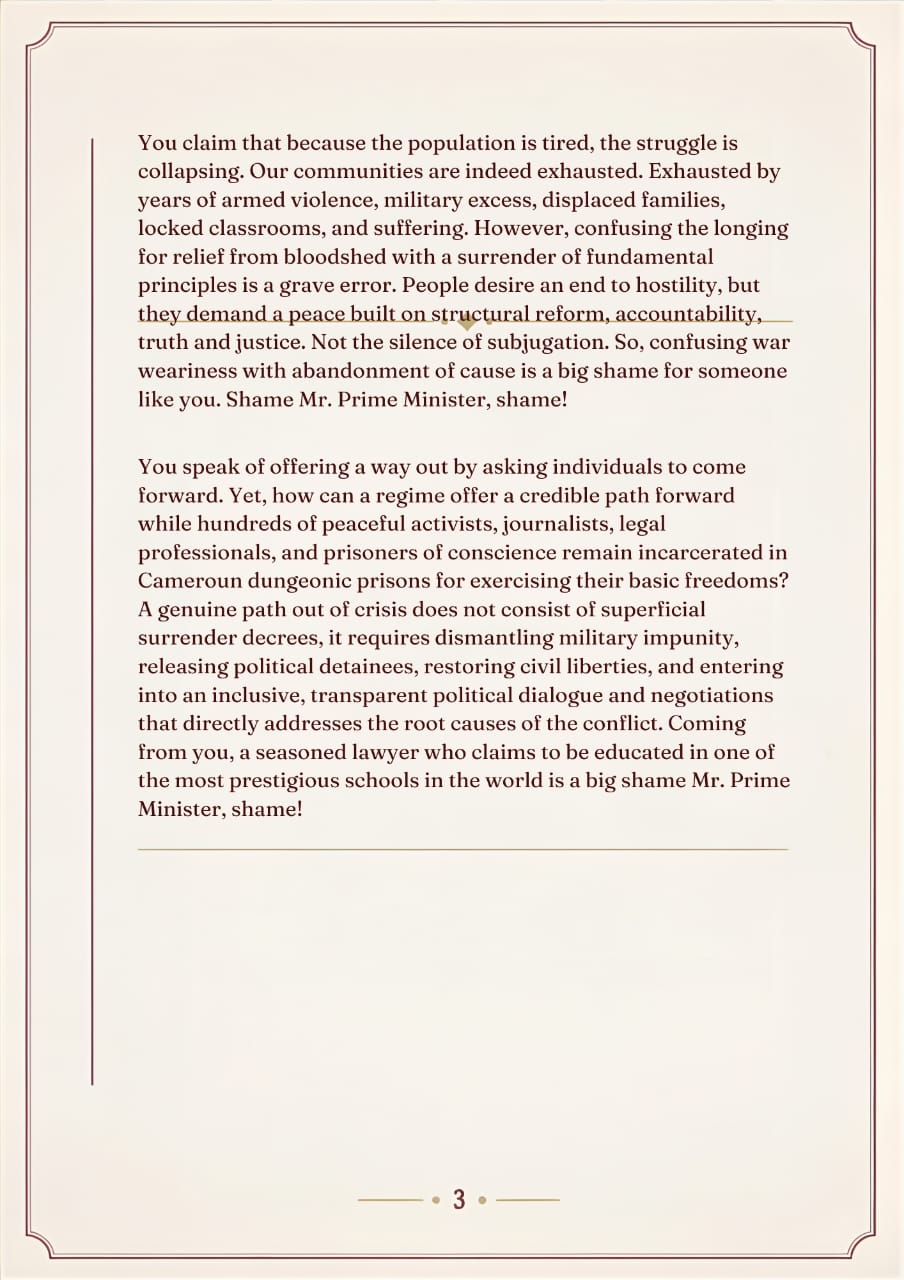
Conrad acknowledges that communities in Cameroon’s English-speaking regions are exhausted by years of violence, displacement, disrupted schooling and suffering. But he disputes the suggestion that this exhaustion amounts to acceptance of existing political conditions.
“Confusing the longing for relief from bloodshed with a surrender of fundamental principles is a grave error,” he wrote.
In his account, people want an end to hostilities alongside structural reform, accountability and justice. He argues that ending violence without addressing those demands would leave the underlying conflict unresolved.
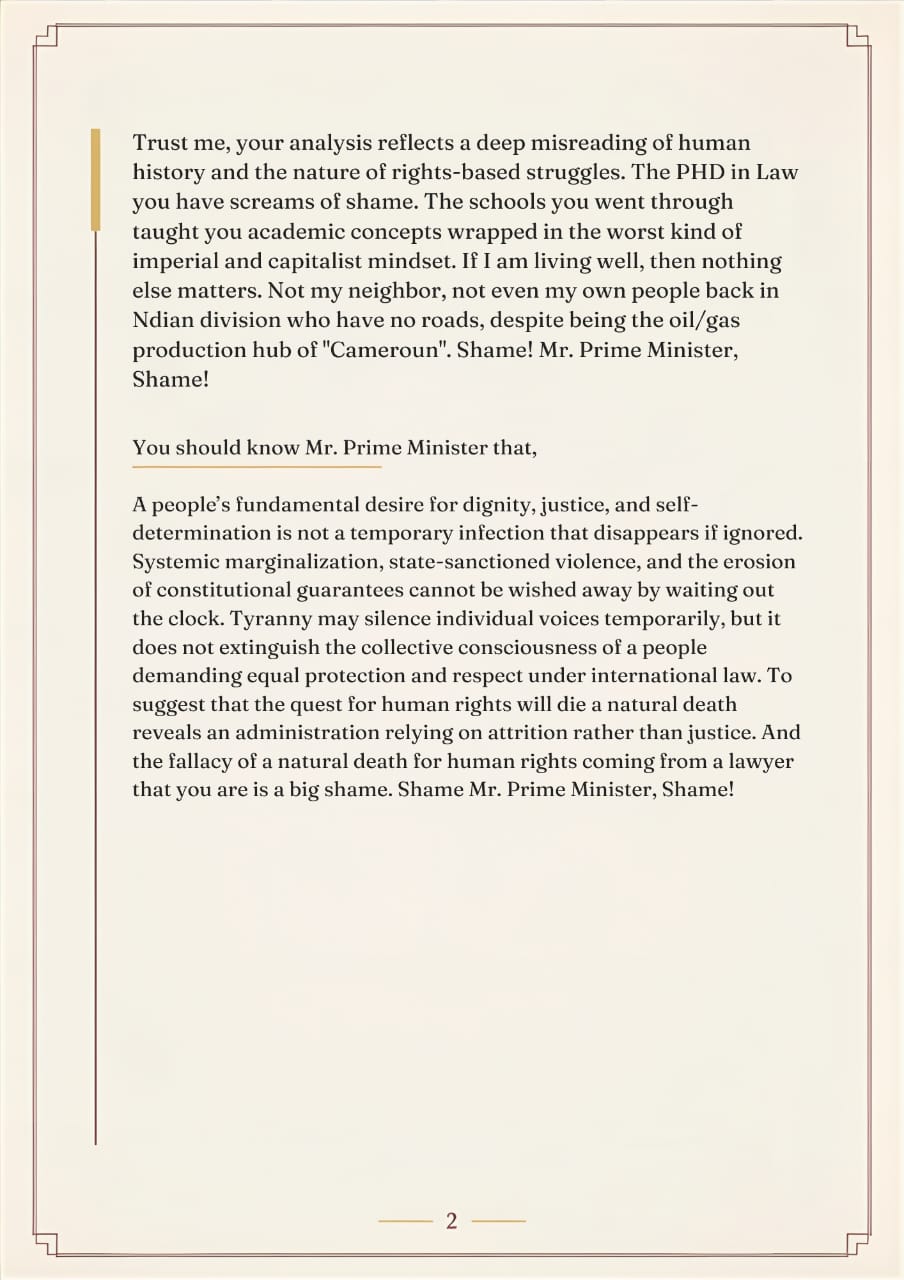
“A people’s fundamental desire for dignity, justice, and self-determination is not a temporary infection that disappears if ignored,” the letter states.
Conrad refers throughout the letter to “Southern Cameroons”, framing the grievances of the North-West and South-West regions as a struggle for rights and political recognition.
He accuses the administration of pursuing a strategy of attrition: expecting the demand for change to weaken as communities endure further years of hardship.
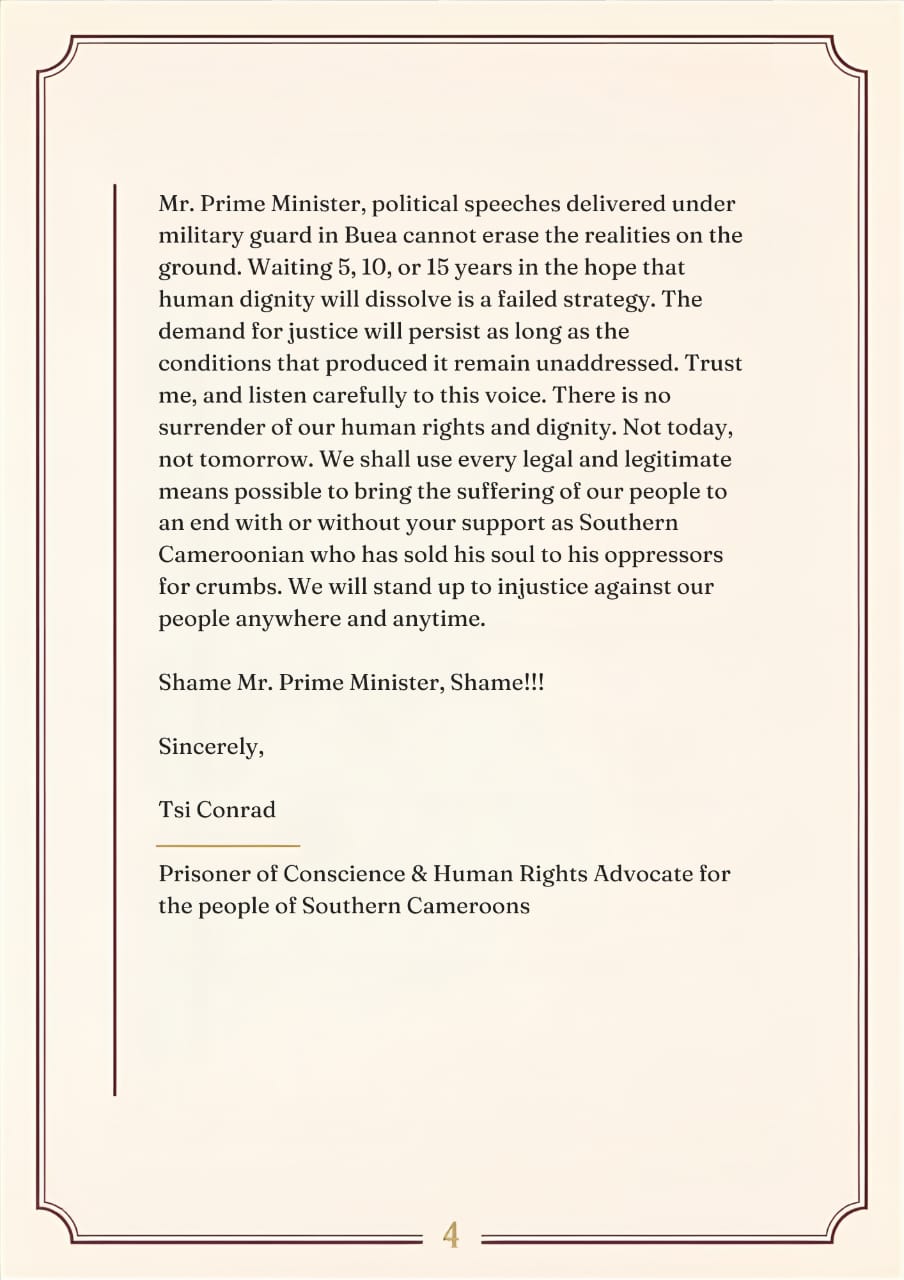
“Waiting 5, 10, or 15 years in the hope that human dignity will dissolve is a failed strategy,” he wrote.
Calls for detainees’ release and political negotiations
The letter also questions the credibility of government appeals for individuals to come forward and abandon the struggle while political detainees remain imprisoned.
Conrad says the continued incarceration of what he describes as hundreds of peaceful activists, journalists, legal professionals and prisoners of conscience undermines any claim that the government is offering a genuine route out of the crisis.
His proposed response includes releasing political detainees, ending military impunity, restoring civil liberties and establishing an inclusive, transparent process of dialogue and negotiations.
He argues that negotiations must directly address the conflict’s root causes, rather than focus principally on persuading individuals to surrender.
“A genuine path out of crisis does not consist of superficial surrender decrees,” he wrote.
The criticism is also directed personally at Dion Ngute. Conrad repeatedly uses the word “shame”, questions the prime minister’s interpretation of human rights and challenges his responsibilities as an Anglophone politician with legal training.
Dion Ngute’s official biography records a doctorate in law from the University of Warwick and identifies him as the traditional ruler of Bongongo I in Ndian Division.
Conrad points to Ndian as an example of what he considers government neglect, arguing that communities lack adequate roads despite the division’s role in oil and gas production.
He contends that the prime minister’s education and connections to the region should make him more responsive to its grievances.
Nearly a decade in detention
Tsi Conrad’s demand for the release of detainees comes from his own prolonged imprisonment.
According to the Committee to Protect Journalists (CPJ), the filmmaker and photographer was arrested in Bamenda on 8 December 2016 while filming demonstrators during unrest linked to the Anglophone crisis.
On 25 May 2018, a military court sentenced him to 15 years in prison on charges including terrorism, secession, hostility against the state, rebellion and spreading false news.
CPJ reports that an appeals tribunal overturned his convictions for terrorism and rebellion in August 2021, while leaving other convictions in place.
The organisation also records that the United Nations Working Group on Arbitrary Detention found his detention arbitrary in 2021 and called for his immediate release and compensation.
Conrad filed a further appeal to Cameroon’s Supreme Court in August 2023. CPJ’s account states that, as of early 2026, no new hearing date had been set.
In the September letter, Conrad identifies himself as a prisoner of conscience and human rights advocate, presenting his imprisonment as part of the wider restrictions on freedoms that he wants negotiations to address.
A conflict rooted in the 2016 protests
The Anglophone crisis began in 2016 with protests by English-speaking lawyers and teachers over marginalisation and the treatment of the regions’ legal and education systems.
The security crackdown and subsequent escalation developed into an armed conflict between government forces and separatist groups seeking independence.
The Global Centre for the Responsibility to Protect has documented killings, arbitrary detention, torture and other abuses by security forces, alongside killings, kidnappings and attacks on education by armed separatists. Its March 2026 assessment said the conflict remained unresolved and continued to threaten civilians, despite a decline in deadly separatist attacks in recent years.
The Buea meeting has also prompted calls for sustained consultations beyond the gathering itself. Lawyer and human rights advocate Nkongho Felix Agbor, who attended, said displaced families, women, young people, teachers and others directly affected by the conflict must have meaningful opportunities to participate, according to Cameroon News Agency. He also called for a similar dialogue opportunity in the North-West.
Tsi Conrad closes his letter by pledging to pursue legal and legitimate means to end the suffering of Anglophone communities, with or without the prime minister’s support.
“There is no surrender of our human rights and dignity,” he wrote. “Not today, not tomorrow.”

