


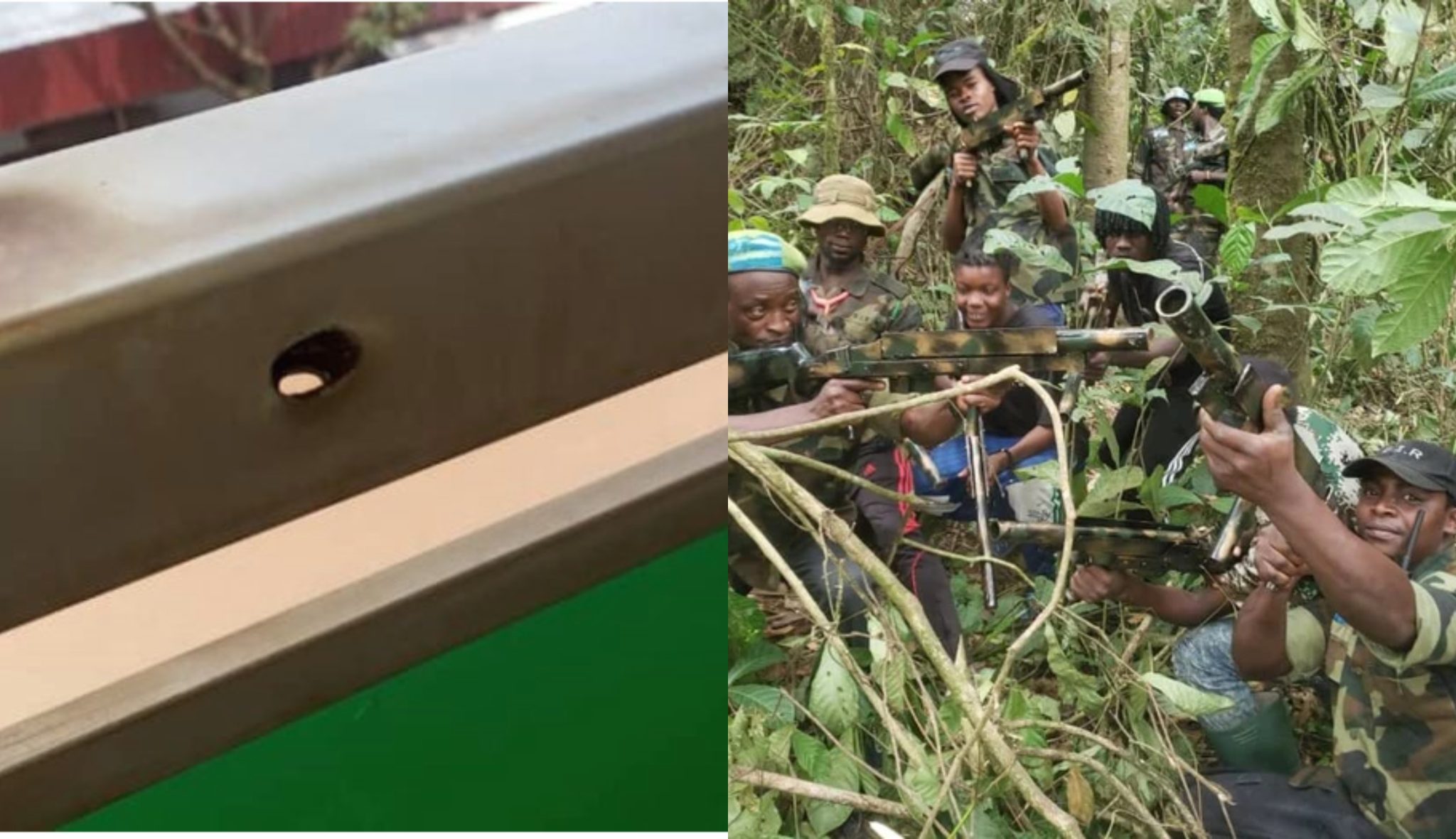
Gunfire shattered the quiet of Bamenda’s Meta Quarters in the early evening of April 3rd. It was another scene in what has become all too common in the ongoing Anglophone crisis. Witnesses say bullets ripped through a residential building as armed separatist fighters stormed the neighbourhood. They demanded to know the whereabouts of a young woman, Eunice Chifu.
Shouting in Pidgin English, “Wusai e dey?” (“Where is she?”), the men terrorised tenants of the compound believed to house Chifu’s family. With no one home, the fighters dragged two neighbours from their apartments and forced them to answer for her absence. Before leaving, they fired multiple rounds into the metal sheet walls and left a chilling message. They said, if Eunice didn’t contact them, she would be labelled a “blackleg,” a term often preceding a death sentence.
“They pulled us out and said, ‘Tell us where she di hide. If wuna no talk, we go burn this place,’” one tenant later recalled under anonymity. “We begged. We said we no even sabi the girl.”
Chifu’s supposed crime? Past ties to a soldier, a connection reportedly flagged by separatist intelligence years earlier, branding her a “reserved fighter.”
The Shadow War on Women
This harrowing incident is part of a broader, grim trend in the conflict-ridden Northwest and Southwest regions of Cameroon. As the Anglophone crisis stretches into its ninth year, women and girls have increasingly become targets of violence, suspicion, and execution by non-state armed groups, often under the thinnest accusations of collaboration with state security forces. Apart from high-profile cases such as that of prison officer Florence Ayafor, who was murdered and beheaded, there are other cases.
Comfort Tumasang’s Execution – Muyuka, 2020
In one of the most brutal incidents, Comfort Tumasang, a mother of four, was beheaded in broad daylight by separatist fighters in Muyuka after being accused of sharing information with the army. A graphic video of the incident circulated online, showing the woman pleading for her life. No one intervened.
“She begged. She said she was innocent. They didn’t care,” said a witness who saw the video. “It was meant to send a message.”
Students Stripped and Beaten – Buea, 2022
In Buea, four teenage girls, aged between 14 and 18, were forcibly stripped naked and whipped by separatists while on their way to school. They were accused of defying lockdown orders and “aiding the enemy” by attending classes.
“They told us, ‘You want to learn? Learn this pain,’” one of the victims later told Human Rights Watch.
Kidnapping of Protesters – Babanki, 2023
In another case, about 30 mainly older women were abducted in Kedjom Keku after protesting illegal separatist taxes. Videos later emerged showing them in captivity, with one fighter shouting, “Wuna di work with La République. We go deal with all man.”
Some of the women were released after days of torture. Others have yet to return.
No Safe Harbor
What unites these cases isn’t just brutality; it’s the near-total absence of protection or justice.
“There is no one to turn to. The army cannot protect you, and the separatists treat you as a traitor if you even say hello to a soldier,” said a rights worker in Bamenda, who asked not to be named for security reasons.
Victims fear reporting attacks, and when they do, little action is taken. State security forces are themselves frequently accused of human rights abuses, making them untrustworthy in the eyes of civilians.
In Eunice Chifu’s case, a witness remembered seeing a military vehicle parked outside her house during the 2024 Christmas period — likely the trigger for her current predicament. But whether or not she had any affiliation, the consequence is the same: she is now a marked woman.
A War With No Rules
Even separatist leadership appears divided or powerless to rein in rogue fighters. In 2024, the Ambazonia Defence Forces (ADF) publicly executed two civilians in Batibo for allegedly working with government forces. While the act triggered international condemnation, it did not stop the cycle of revenge and suspicion.
“Once they put your name on a blacklist, that’s it,” said a humanitarian working in the Northwest. “There’s no trial. No defense. Just bullets.”
The use of fear, public executions, and humiliations, especially against women, has turned the Anglophone conflict into not just a political crisis but a gendered one. Girls are pulled out of schools, women are silenced, and their bodies turned into battlegrounds.
A Cry for Justice
The attack on Eunice Chifu’s family, and the countless others like it, signals more than just the desperation of a war-weary region — they reveal a society fractured by impunity. With no functioning mechanisms of justice or protection, civilians are left to fend for themselves in the crossfire of an unwinnable war.
“These women are not soldiers. They’re not spies. They’re just living, and that has become a death sentence,” said a local women’s group leader.
Until both separatist factions and state actors are held to account, and until civilians are treated as non-combatants instead of tools of war, the women of Cameroon’s Anglophone regions will continue to live with fear knocking at their doors.

