



Fru adjusts his school bag and joins the stream of pupils making their way to class to sit for the First School Leaving Certificate. At 13 years old, he should be preparing to enter Form Three. Instead, he is taking his first steps into secondary school.
“I started late,” he says softly.
For three years, Fru stayed at home as armed conflict engulfed Cameroon’s North West Region. His parents feared sending him to school amid reports of violence and attacks linked to the crisis that erupted in 2016.
While children elsewhere progressed through primary school, Fru watched from home as his education stood still.
Now back in the classroom, he is trying to make up for lost time.
“I want to continue studying,” he says. “I want to be an engineer in future.”
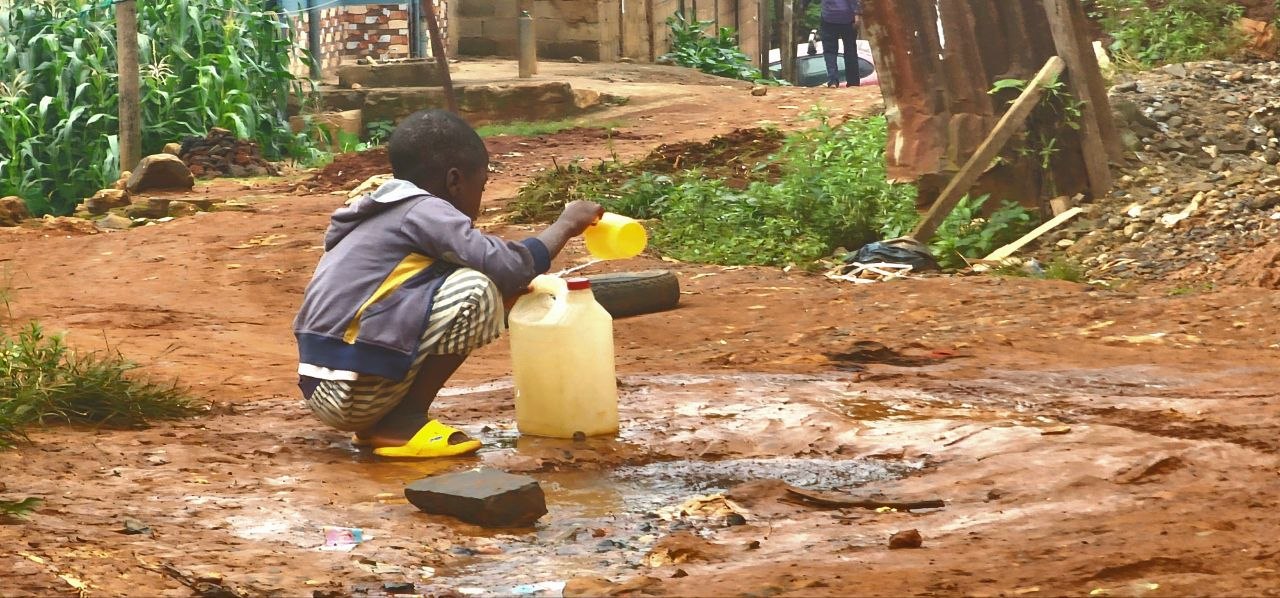
As Africa marks the Day of the African Child under the theme, “Ensuring Universal Access to Water, Sanitation and Hygiene for Every Child in Africa,” Fru’s story highlights a different reality confronting many children in Cameroon’s conflict-affected Anglophone regions: the struggle to access not only clean water and sanitation, but also education, safety and hope.
A few kilometres away, in Ntarinkon, Manka, whose name has been changed to protect her identity, uses the light from a mobile phone to stitch patterns onto a traditional dress.
The teenager should be preparing for Ordinary Level examinations next year. Instead, she is only moving into Form Two.
Like Fru, conflict forced her out of school. But unlike him, she lost four years.
Before the crisis disrupted her education, Manka dreamed of becoming a medical doctor.
Her parents say that dream is slowly slipping away.
“When she was younger, she always talked about becoming a doctor,” says her mother. “Now she is far behind in school because of the conflict, she is loosing that steam but we have kept encouraging her”
Manka refuses to give up completely. When she is not studying, she spends hours learning traditional dressmaking and embroidery, skills she hopes could provide an alternative future if her academic ambitions do not materialize.
The stories of Fru and Manka are far from unique.
Nearly a decade after the outbreak of the Anglophone conflict, thousands of children continue to bear its consequences. Years of insecurity, school closures, displacement and economic hardship have left many struggling to reclaim their education and rebuild their lives.
According to a UNICEF report published on May 5, 2026, some 1.5 million children in Cameroon require humanitarian assistance.
For children in the North West and South West regions, the challenges often overlap. Families struggling with insecurity also face difficulties accessing healthcare, clean water, sanitation facilities and stable livelihoods.
Child rights advocates warn that the long-term impact may extend far beyond missed school years. Delayed education, interrupted childhoods and prolonged exposure to violence risk creating a generation whose potential has been severely constrained by conflict.
Yet despite the setbacks, children like Fru continue to show remarkable resilience.
As day one of the FSLC ends for the day, he returns home preparing for the second and last day. For a moment, the years lost to conflict seem distant, but they are never completely forgotten.
Every lesson he learns today is one he should have learned years ago.
As Africa celebrates its children, Fru’s journey in Cameroon’s Anglophone regions, is a reminder that the right to childhood remains a goal they are still struggling to recover.